Barriers to Inclusivity in the Solar Value Chain [Event Invitation]
JustGESI XChange Series
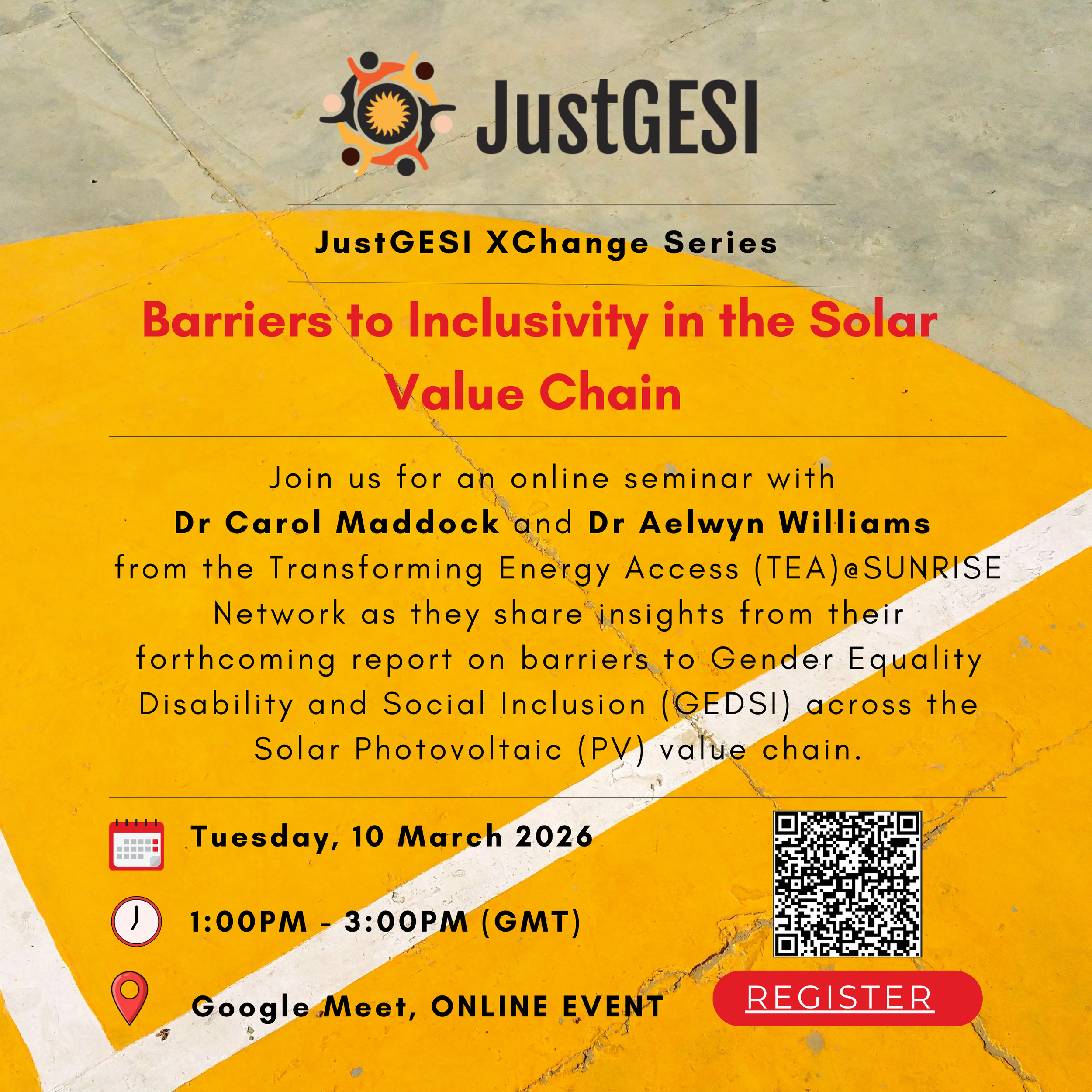
Join us for a special online seminar featuring colleagues from the Transforming Energy Access (TEA)@SUNRISE Network, Dr Carol Maddock and Dr Aelwyn Williams.
Part of the Transforming Energy Access (TEA) platform, funded by UK aid from the UK Government, TEA@SUNRISE aims to accelerate the adoption of next-generation solar technologies through research, innovation, and partnerships.
In this session, our speakers will share insights from their forthcoming report,
‘Barriers to Inclusivity in the Solar Value Chain: Africa, Asia, and the Indo-Pacific Region.’
The report examines the structural and systemic barriers that shape who is included and excluded across the solar photovoltaic (PV) value chain. It highlights how colonial legacies, gendered and patriarchal norms, and uneven capital flows continue to influence renewable energy sectors across different regions.
Through a Gender Equality, Disability, and Social Inclusion (GEDSI) lens, the authors emphasise the urgent need for more intentional and justice-driven approaches to energy transitions. Without such attention, efforts to accelerate solar solutions in response to climate change pressures risk reproducing historical inequalities, deepening marginalisation, and reinforcing patterns reminiscent of earlier models of unequal development.
Event Details
Date: Tuesday, 10 March 2026
Time: 1-3pm (GMT)
Format: Online seminar
Sign -up link: https://forms.gle/yh9kcuPAqPW13Kj48
This seminar is organised as part of the JustGESI XChange Series, a platform dedicated to fostering knowledge sharing, collective learning, and critical dialogue on justice-oriented approaches to global energy transitions.
Participants are warmly encouraged to bring questions, reflections, and examples from their own contexts for an open discussion.
About the Speakers
Dr Carol Maddock and Dr Aelwyn Williams are Senior Researchers within the TEA@SUNRISE team, supporting all TEA@SUNRISE activities. Their roles focus on embedding inclusion across the project by leading research and capacity‑building initiatives that enable partners and network members to design and deliver more equitable energy solutions. They also work with other TEA infrastructure team to develop practical GEDSI tools and guidance.
