
Barriers to Inclusivity in the Solar Value Chain: Key Insights from a JustGESI Xchange Seminar
Written by Dr Sangita Thebe Limbu, JustGESI Postdoctoral Research Associate
Solar photovoltaic (PV) technology has emerged as one of the cornerstones of the global energy transition. Solar PV, which uses solar cells to convert sunlight directly into electricity, has expanded at an unprecedented pace, reaching nearly two terawatts of installed capacity worldwide by the end of 2024. In recent years, solar power has accounted for the largest share of new renewable energy capacity additions, outpacing all other renewable technologies.
This expansion has been driven in part by significant cost reductions, with solar now cheaper than fossil fuel alternatives in many contexts. The sector is also a major source of employment, supporting millions of jobs globally across manufacturing, installation, and maintenance. According to IRENA’s 2026 report, 7.2 million jobs were created in the solar energy sector in 2024, the highest of any renewable energy technology.
Despite this rapid growth, the benefits of solar PV technology remain unevenly distributed. A small group of countries dominate global solar PV manufacturing and installation capacity, with China playing a particularly prominent role. Many countries in Africa, Asia, and the Indo-Pacific are positioned primarily as suppliers of raw materials, land, or low-wage labour, while capturing only limited economic or social value from solar investments. These persistent imbalances warrant deeper engagement with questions of ethics, equity, justice, and sustainability across the solar PV value chain.
These important issues were examined during a JustGESI Xchange online seminar held on 10 March 2026. Dr Carol Maddock and Dr Aelwyn Williams from the Transforming Energy Access (TEA)@SUNRISE Network at Swansea University joined the session and shared important insights from their now published report, Barriers to Inclusivity in the Solar Value Chain: Africa, Asia, and the Indo-Pacific Region.
Part of the Transforming Energy Access (TEA) platform, funded by the UK aid from the UK Government, TEA@SUNRISE aims to accelerate the adoption of next-generation solar technologies through research, innovation, partnerships and knowledge exchange.
Adopting a Gender Equality, Disability, and Social Inclusion (GEDSI) lens, Carol and Aelwyn’s report examines the structural and systemic barriers that shape who is included and excluded across the solar PV value chain. The report draws on academic and grey literature, case studies contributed by the TEA@SUNRISE network, and insights from experts working across the solar energy sector. This article provides an overview of their presentation, based on the report’s findings, and highlights some of the key takeaways for those working on energy research.
Cover page of the report by Dr Carol Maddock and Dr Aelwyn Williams (Photo Credit: TEA@SUNRISE)
A GEDSI Lens on the Solar PV Value Chain
Both Carol and Aelwyn began the presentation by elaborating on the GEDSI framework that underpinned their work and explained how they approached some of the key concepts such as gender. They explained that in their project, gender is not treated as a fixed attribute but as a system of power shaped by colonial histories and patriarchal social relations. Their analysis is informed by an intersectional approach that pays attention to how gender intersects with class, caste, race, disability, age and Indigeneity to produce compounded disadvantage.
Another key concept in their work is epistemic justice, which involves examining whose knowledge counts in shaping solar research, policy, and practice, and whose knowledge and expertise are marginalised or excluded.
Mapping the Solar Value Chain
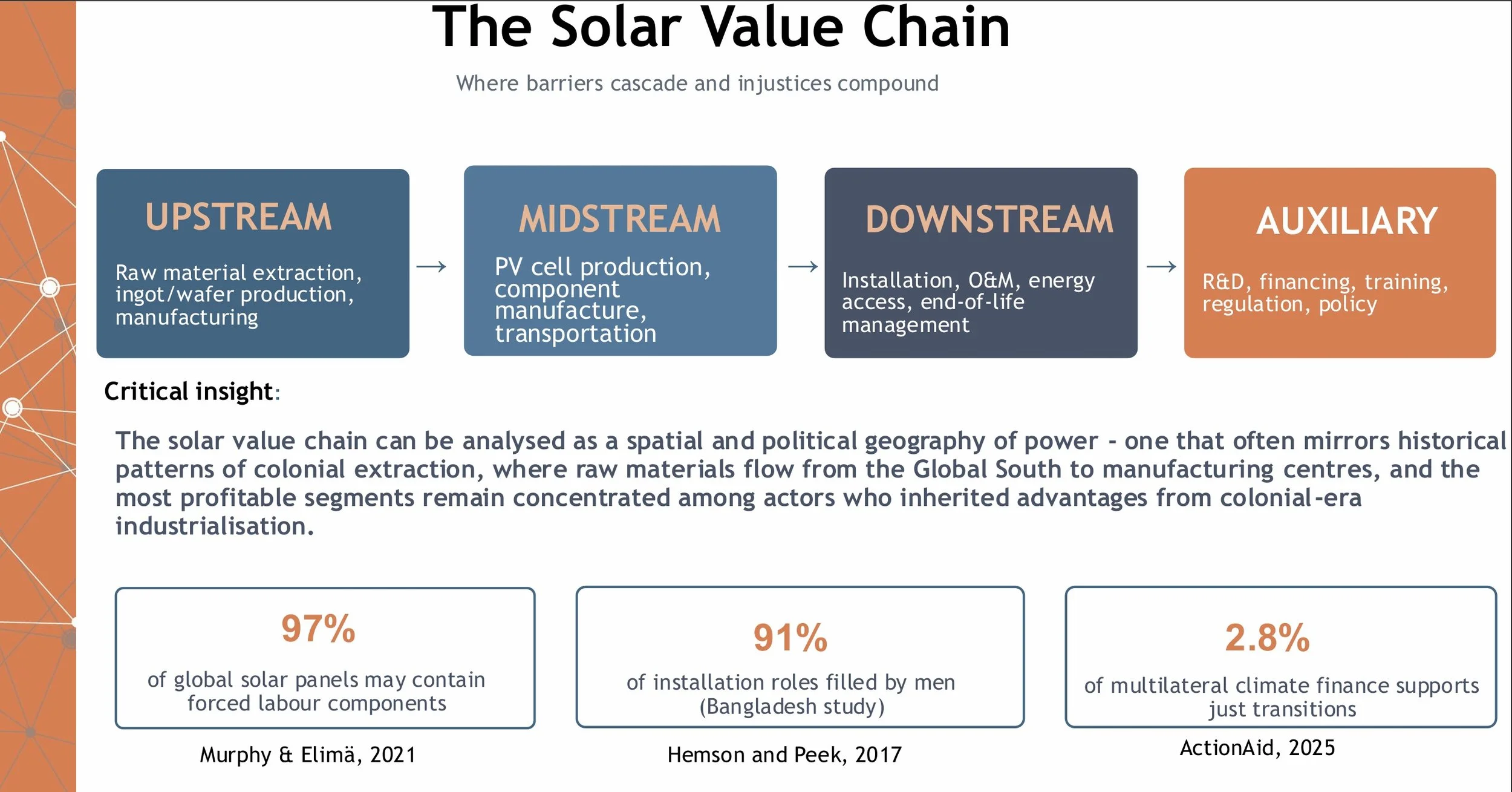
Selected slide shared by Carol and Aelwyn during their presentation.
Carol and Aelwyn highlighted how they examined inclusivity across four interconnected segments of the solar PV value chain. Here is a brief overview of each of those segments and what they entail:
Upstream
This stage includes the extraction of critical minerals such as silica and silver, the processing of raw materials into wafers, cells, and structural components, the manufacture of materials such as steel, aluminium, glass, and encapsulating film, and system design and engineering. Upstream activities require specialised knowledge and technological capacity and capture the highest value within the global photovoltaic industry, typically generating the largest profits.
Midstream
The midstream stage focuses on the manufacture of components for photovoltaic modules, such as cables, frames, sealing silicone, and junction boxes, as well as inverters, mounting structures, transportation, and logistics. This segment is often characterised by lower entry barriers and intense competition, resulting in lower profit margins.
Downstream
The downstream stage brings solar technologies into direct contact with users and includes installation, operation, maintenance, decommissioning, waste management, and recycling. These activities shape everyday energy access and local employment opportunities.
Auxiliary
The auxiliary segment comprises firms and organisations essential to the sector’s development, including research and development, finance, regulation, training, and governance. The actors involved play a critical role in determining who participates in and benefits from solar transitions.
Systemic Barriers in the Solar Value Chain
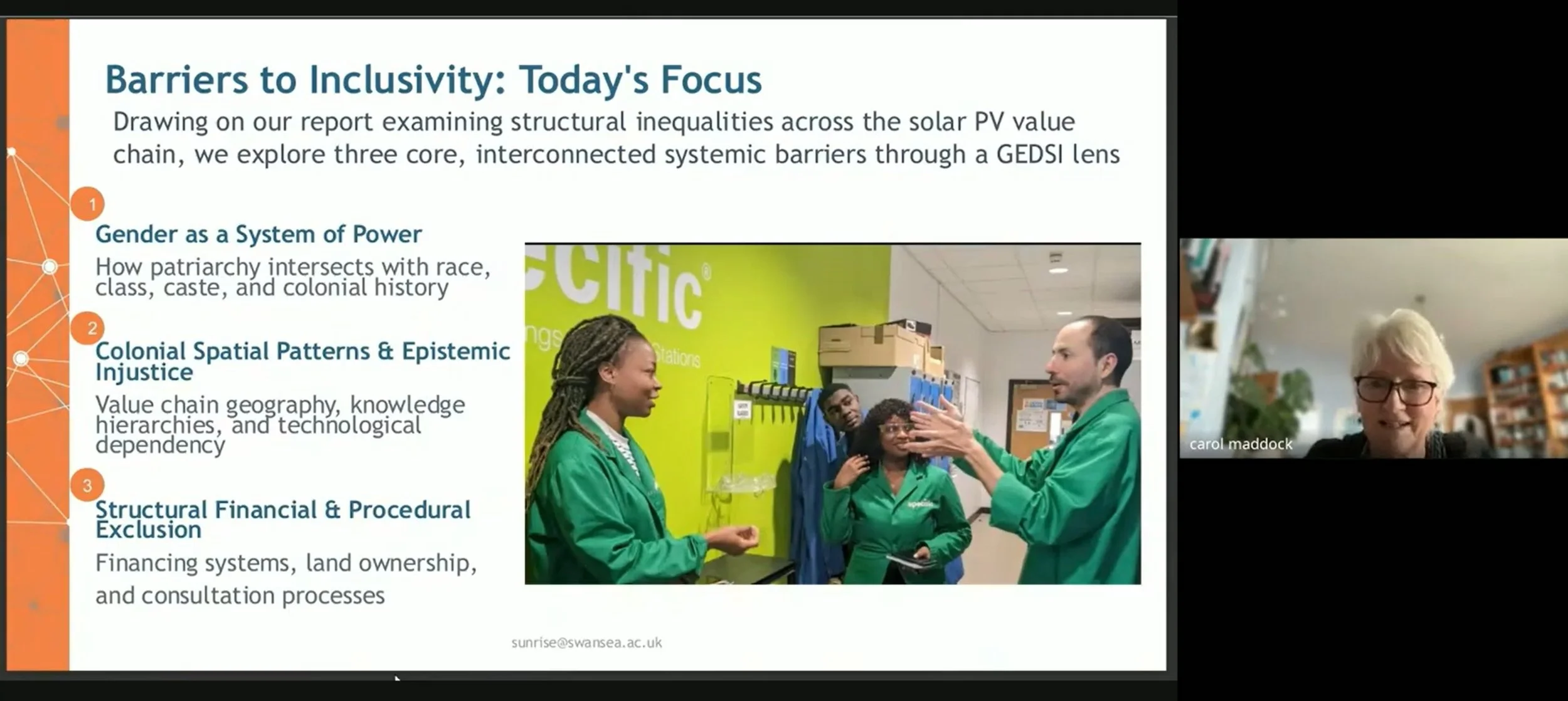
Using a GEDSI lens, the report identifies the following three interconnected systemic barriers across the solar PV value chain:
Gendered Power Relations and Labour Segmentation
One of the most significant barriers identified is the operation of gender as a system of power in shaping inclusion and exclusion across the solar PV value chain. In many contexts, girls are discouraged from pursuing STEM (Science, Technology, Engineering, Mathematics) pathways through gendered expectations, biased educational guidance, and hostile learning environments. These barriers persist into professional life, contributing to male-dominated solar workplaces.
Workplace cultures, recruitment networks, and safety narratives often reinforce exclusion. Even when women receive technical training, they are frequently concentrated in specific roles such as assembly or service work, while men dominate installation, management, and ownership positions. This gendered segmentation restricts women’s access to higher-paying roles and decision-making power across the value chain.
Carol and Aelwyn highlighted a case study from Bangladesh showing that, despite women receiving training in production, assembly, and servicing, the solar value chain remained rigidly gender segmented. Women accounted for 91 percent of assembly work, while 91 percent of installation work was carried out by men. As a result, women’s jobs did not generally draw on their acquired skills in promotion, installation, and maintenance of solar home systems, nor were they engaged in the higher-value segments of the company associated with rising sales.
Colonial Spatial Inequalities and Epistemic Injustice
A second major barrier relates to the geographical organisation of the solar industry and the concentration of high-value activities in a small number of countries. Research, innovation, and advanced manufacturing are clustered in the Global North and in China, while many countries in the Global South host large-scale solar projects without capturing commensurate benefits.
Technical and policy expertise from the Global North often dominates, while Indigenous and locally grounded knowledge, including women’s ecological expertise, remain marginalised.
Carol and Aelwyn further highlighted case studies from India that illustrate how internationally celebrated solar parks can deepen local economic insecurity. Local communities experience land loss and disrupted livelihoods, while revenues and skilled employment often flow elsewhere. Similarly, mineral extraction for solar manufacturing has displaced forest-dependent communities, with women and children bearing disproportionate social and environmental costs. Across these contexts, local and Indigenous knowledge is sidelined in project design and policy processes.
Financial and Procedural Exclusion
Financial systems and decision-making processes further reinforce inequalities. Women’s limited access to land ownership, assets, formal employment, and mobility undermines their financial credibility in contexts where solar financing depends on collateral or formal credit histories. Pay-as-you-go models can also reproduce exclusion through credit-scoring mechanisms that privilege people with stable, formal employment and financial histories, thus excluding many women.
Procedural exclusion is equally significant. Community consultations are typically organised around male landowners or local elites, marginalising women’s and other socially excluded groups’ voices and priorities. Policies that appear neutral can reinforce inequality by linking subsidies or incentives to property ownership or formal registration, effectively excluding many women and marginalised communities by design.
Carol and Aelwyn highlighted a case study from the Kaleo-Lawra Solar Plant in Ghana that illustrates these dynamics. Local communities, particularly women who rely on forest resources, reported being excluded from project benefits, including access to energy and employment. Most jobs created by the project were temporary, while skilled positions were filled by non-local men. Women were largely confined to feminised service roles such as cooking and cleaning, yet bore the primary costs of land dispossession and livelihood loss.
Human Rights and Ethical Issues in Solar Supply Chains
Carol and Aelwyn also highlighted serious ethical concerns within the global solar supply chains. Drawing on research by Sheffield Hallam University, they pointed to evidence of forced labour in parts of the polysilicon production supply chain, particularly involving Uyghur communities in China. This raises profound questions about the ethical foundations of contemporary clean energy transitions.
Research from Sheffield Hallam University further indicates that approximately 45% of the world’s solar-grade polysilicon supply in 2020 originated in the Uyghur region of China, where there is documented evidence of coercive labour conditions affecting Uyghur populations (Murphy and Elimä, 2021). As polysilicon is a critical input for around 95% of solar panels, a significant share of the global photovoltaic production may therefore be linked to supply chains involving forced labour.
More recent analysis suggests that, while this share has declined, exposure remains substantial. By 2023, the Uyghur region accounted for roughly 35% of global polysilicon production (down from 45%) and up to 32% of metallurgical-grade silicon output. Despite this reduction, the majority of solar modules produced worldwide continue to have some level of exposure to the region, particularly where manufacturing is concentrated in China (Crawford and Murphy, 2023).
Feminist and human rights analyses further highlight the gendered dimensions of coercion within these supply chains, including intensified surveillance, restricted mobility, and forms of control that disproportionately affect women. Taken together, these findings challenge narratives that present renewable energy supply chains as inherently ethical or ‘clean’, underscoring instead the need for greater transparency, accountability, and robust enforcement of human rights standards across the solar sector.
Towards a Just Solar Transition
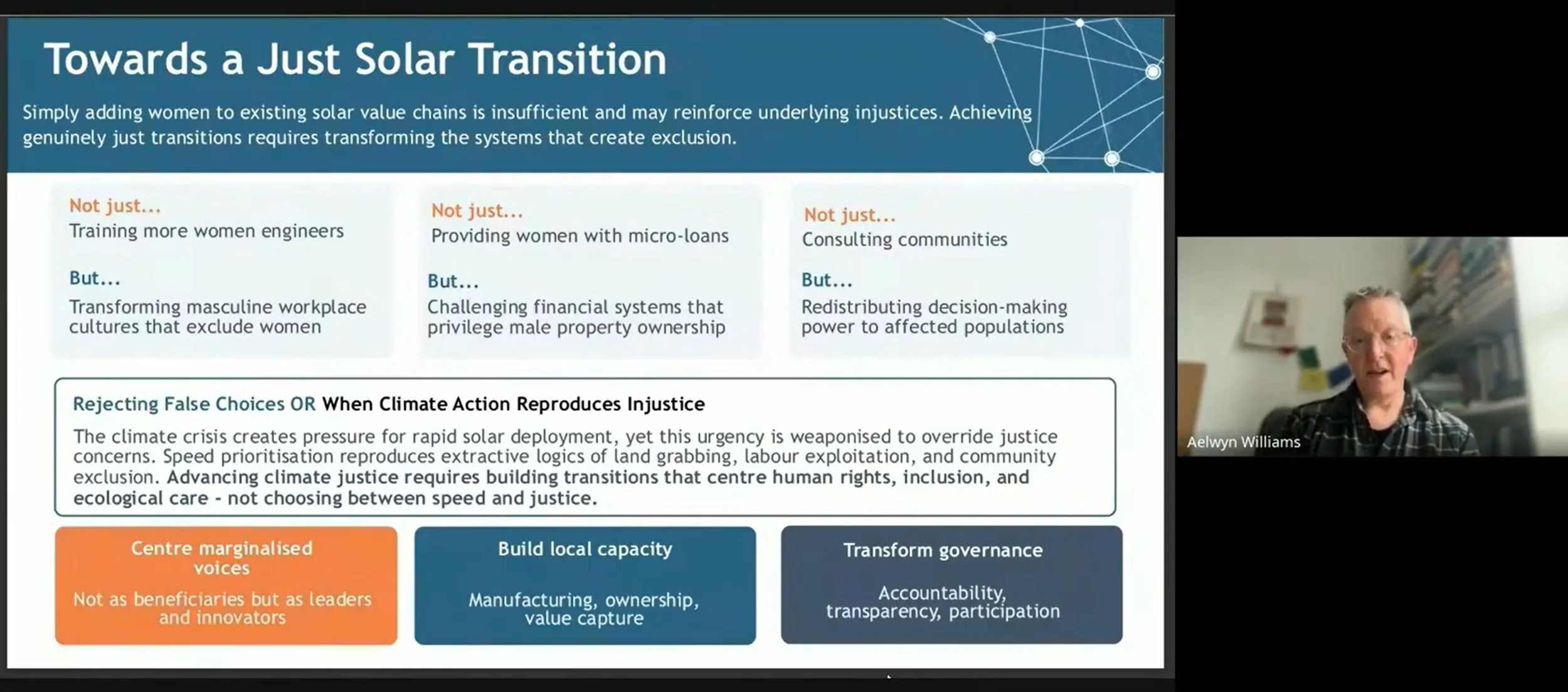
Aelwyn and Carol concluded by outlining measures for advancing a just solar transition. Increasing participation within existing structures, they argued, is insufficient. Without transforming the systems that produce exclusion and marginalisation, inclusion initiatives risk reproducing inequality under the banner of green development.
A genuinely just solar transition, therefore, requires reshaping workplace cultures, reforming financial architectures, and redistributing decision-making power to affected communities. While the urgency of climate action is often used to justify rapid solar deployment, prioritising speed over justice risks reinforcing extractive practices. Advancing climate justice requires transitions that centre human rights, inclusion, and ecological care alongside decarbonisation goals. This means recognising marginalised groups not merely as beneficiaries of solar transitions, but as leaders, decision-makers, and innovators shaping solar futures.
Key Takeaways
Below are some of the key takeaways from this valuable presentation for those working on gender and social inclusion in energy research and practice:
Gender should be understood as a structural system of power rather than as synonymous with women. Analysing gender in this way requires attention to how it intersects with other social identities and relations, as well as with capitalist and colonial histories, to produce differentiated access to resources, labour, and decision-making across the solar PV value chain.
A transnational, value chain-wide perspective is essential for understanding inequality in solar transitions. Risks and benefits, as well as profits and losses, are distributed unevenly across regions and stages of the value chain, often concentrating value in a small number of locations while externalising social and environmental costs elsewhere.
Interventions that focus on the entire solar PV value chain are better positioned to address structural barriers. Isolated or downstream inclusion initiatives are insufficient if upstream production, finance, governance, and knowledge systems continue to reproduce exclusion.
Balancing speed and urgency with human rights, inclusion, ecological care, and justice is critical. Without explicit attention to these dimensions, rapid solar deployment risks reproducing extractive and exclusionary patterns that mirror those of fossil fuel-based energy systems.
A full recording of the presentations is available through this link.
The full report, Barriers to Inclusivity in the Solar Value Chain: Africa, Asia and the Indo-Pacific Region, is now available on the TEA@SUNRISE website.
