Insights from the GEO-7 report for the project JustGESI
Written by Professor Vanesa Castán Broto
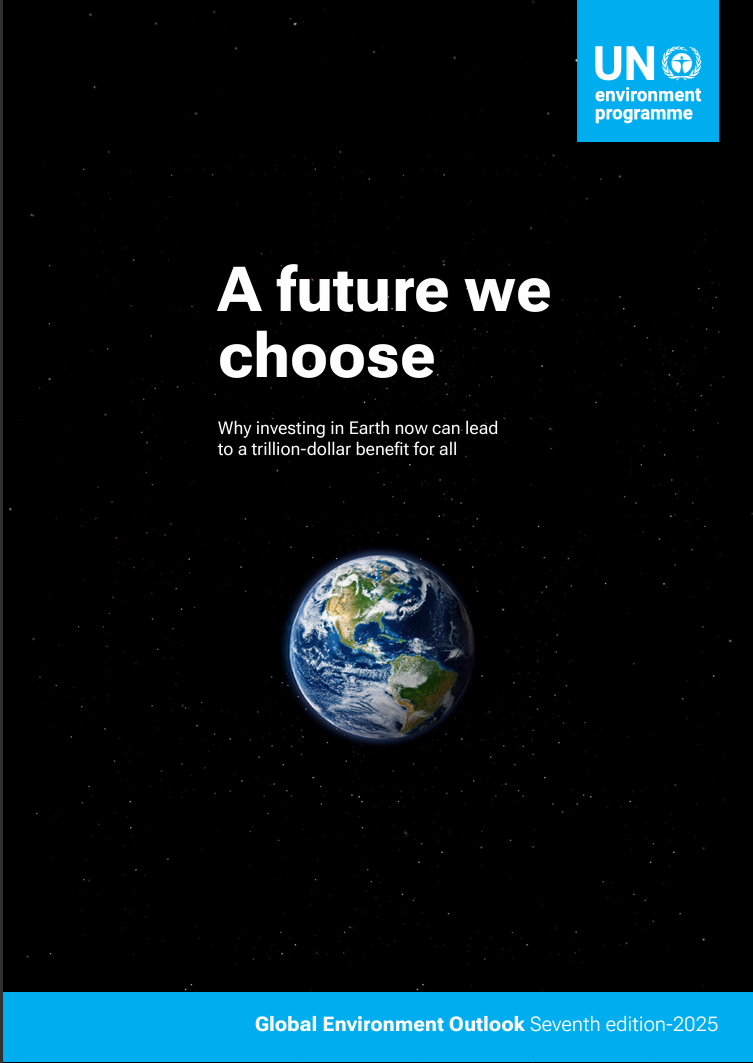
Photo Credit: UN Environment Programme (UNEP)
The report Global Environment Outlook 7: A Future We Choose – Why Investing in Earth Now Can Lead to a Trillion-Dollar Benefit for All (known as GEO-7) was launched at the 7th UN Environment Assembly (UNEA-7) in December 2025, bringing together the insights from 280 scientists across different geographical regions. Since its first edition in 1997, GEO has been the flagship report of the UN Environmental Programme (UNEP).
The latest report marks a turn from diagnosis to action, in line with current international discourse on environmental action, engaging with the complex challenges of facilitating transformative change and placing equity and justice at the centre of any solution pathways. In particular, the report acknowledges a common concern within the scientific community that has long argued that an equitable and just future will require a transformation of multiple interconnected systems, including socio-economic systems, energy, food, material resources and the environment.
What do these transformations consist of GEO-7 proposes a 7-step Goal-Solution-Lever (GSL) Framework to guide transformative action, aiming to be both evidence-based, participatory, and just, while addressing systemic challenges through an adaptive process. The first ‘Goal’ part of the framework focuses on making collective aspirations concrete. The second ‘Solution’ part of the framework aims to map the solution space, starting with an evaluation of ongoing action. The third ‘Lever’ section examines the transformative impacts of short- and medium-term actions, evaluates their interactions, and assesses the capabilities of different actors.
The report emphasises energy transformations, particularly noting that they may face opposition from people who feel excluded from decision-making in a rapidly changing political landscape. There is an underlying theme of energy sovereignty (one of the guiding themes of my own career) running through the report. However, it is not specifically pinned down, even though the report is clear about the need to ground energy transformations in rights-based, equitable, culturally safe, and community-led participatory processes that promote the active involvement of Indigenous Peoples and marginalised communities excluded from decision-making.
Thus, it is not surprising that the report places both community energy and clean cooking at the centre of the Solutions framework, providing pathways for energy system transformation.
One key starting point for such an energy systems transformation is understanding the difference between infrastructure or network coverage and actual access. As the report explains, “having access to the grid does not necessarily mean that a family or community can afford the connection or that the quality of service is adequate” (p. 818). This was one of the key concerns of our international project, Community Energy and Sustainable Energy Transitions (CESET), in which we asked how communities can access the energy services they need, rather than simply relying on electricity networks or renewable technologies. GEO-7 supports the thinking of our project by arguing that “Community energy access can speed up the shift away from energy poverty” (p. 819), highlighting the role that community energy can play in facilitating affordability, multiple productive uses, and social benefits, and praising the potential of diverse innovations such as communal solar systems. The report points towards the power of governments at all levels to “influence, incentivize and constrain actions and behaviours” from “providing an enabling environment for micro-level actions, such as community energy projects, or meso-level actions, including social and environmental movements, as well as new forms of political protests or political lobbying, which can spur new behavioural patterns and social practices” p. 638. As GEO-7 explains, equitable benefit-sharing, together with participatory and inclusive decision-making, are key strategies to ensure that new energy developments do not perpetuate existing injustice, a central concern for CESET and other proponents of community energy.
The question of clean cooking receives extended attention. Still, the discussion at GEO-7 reflects the current state of the debate and the complex challenge of moving away from polluting fuels, as stoves powered by natural gas, liquefied petroleum gas (LPG), bioethanol, and biogas are still widely considered part of the energy transition. There is a real need to continue providing evidence of how renewables can support electric cooking (eCooking) and how eCooking can offer a genuine alternative that finally enables putting fossil fuels away, only tolerable because of the current context of energy poverty and dependence on firewood, charcoal and even more polluting fuels for billions of people.
This is why in the project JustGESI (Mainstreaming Gender Equality and Social Inclusion for a Just Energy Transition), we are committed not only to understanding the potential for expanding the use of eCooking everywhere, but also to advancing a feminist perspective deeply informed by on-the-ground practices, that, like GEO-7 advocates, centres marginalised ways of knowing and emphasises plurality. GEO-7 offers a justice- and rights-based ethos that is needed now more than ever.
If we can choose just one quote from GEO-7 to guide us in future work within JustGESI, I chose the following:
“Recognizing that energy transformations unfold within already affected and inequitable spaces can provide a point of departure for addressing and redressing existing injustices, including co-ownership, revenue sharing, and free, prior and informed consent.”
