JustGESI Finalises Logic Model to Advance Inclusive Energy Transitions in East Africa
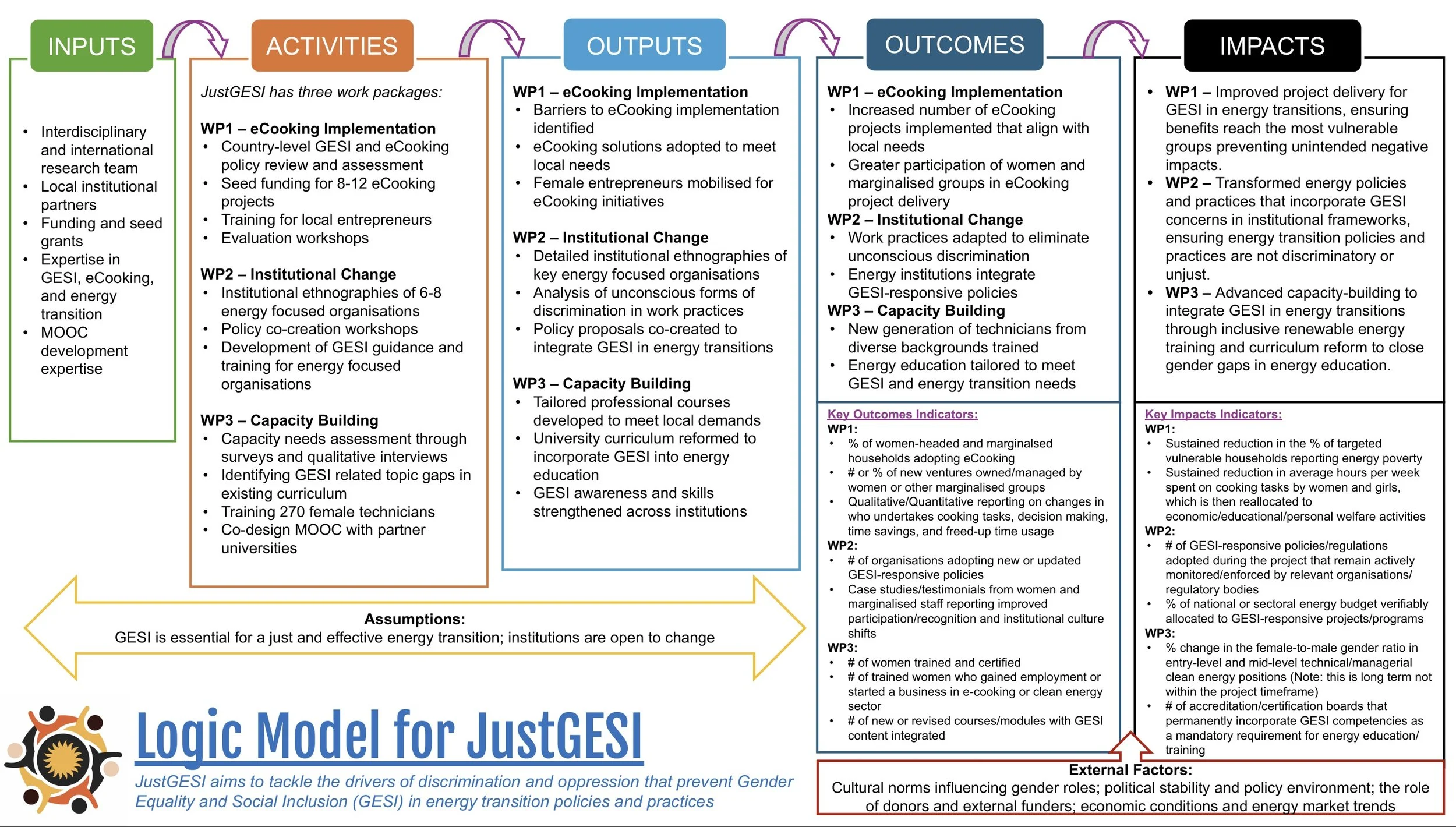
Figure 1: The JustGESI Logic Model
The JustGESI team has finalised its logic model that brings together the project’s interdisciplinary and international research team and local institutional partners in its mission to tackle the drivers of discrimination and oppression preventing the realisation of Gender Equality and Social Inclusion (GESI) in energy transition policies and practices in Ethiopia, Malawi, Mozambique and Tanzania.
Designed to offer a clear and coherent overview, this logic model maps out the UKRI Ayrton Challenge funded JustGESI research project’s key activities across its three work packages. It explains how the project will generate outputs that translate into meaningful institutional and societal change. The logic model also looks beyond the project’s lifetime, outlining the long term impacts it seeks to contribute to across future energy policy, practice, and education systems.
JustGESI’s Three Core Work Packages
At the heart of JustGESI’s approach are three interconnected work packages: eCooking implementation, institutional change and capacity building.
The first work package focuses on supporting locally appropriate eCooking solutions. Activities include conducting GESI and eCooking policy reviews, providing seed funding for community driven eCooking projects, and delivering training for local entrepreneurs. Through these interventions the project aims to boost women’s participation in eCooking project delivery and identify barriers that prevent households, particularly women-headed and marginalised households, from adopting clean cooking technologies.
The second work package investigates how energy organisations operate from within. The team is conducting Institutional Ethnographies across six to eight organisations to uncover hidden practices and unconscious discrimination that shape everyday work in the energy sector. These insights will feed into policy co-creation workshops and the development of guidance to help institutions integrate GESI principles into their policies and operations.
The third work package focuses on capacity building through education and training. The team is assessing capacity needs through surveys and interviews, identifying gaps in existing university curricula, and developing new professional training. A key aim here is to train 270 female technicians as well as co-design a Massive Open Online Course (MOOC) with partner universities to embed GESI perspectives in energy education.
JustGESI’s Outputs, Outcomes, Impacts, and Indicators
Together these activities are expected to generate a set of concrete outputs. These include mobilised female eCooking entrepreneurs, detailed institutional ethnographies, GESI integrated policy proposals, and revised university curricula. Over time, these outputs are expected to drive broader outcomes such as increased participation of women and marginalised groups in energy initiatives, the adoption of GESI responsive organisational policies, and the emergence of a new generation of skilled technicians who better reflect the diversity of the communities they serve.
To track progress, the project has developed a set of outcome indicators. These range from the percentage of women headed households adopting eCooking solutions to the number of women trained and employed in the clean energy sector. Indicators also include organisational uptake of GESI inclusive policies and qualitative evidence of improved participation and recognition among women and marginalised staff within energy institutions.
Constraints, Assumptions, and Way Forward
The logic model acknowledges that meaningful integration of GESI in the energy sector will depend on broader external factors such as cultural norms influencing gender relations, political stability, policy environment, donor involvement, and wider economic and energy market trends. The logic model also builds on the core assumption that GESI is essential for fair and effective energy transitions and that institutions are willing to adapt.
By setting out a structured pathway from inputs and activities to outputs, outcomes, and impacts, the finalised logic model provides the JustGESI research team and its partners, funders, and stakeholders with a clear and coherent vision of what the project aims to achieve and how it intends to get there. It also reinforces the central message of JustGESI: energy transitions will only be just when they work for everyone.
