
JustGESI Researchers Share Insights from the ‘Equality, Diversity and Inclusion (EDI) in Energy Research’ Event
Written by: Dr Sangita Thebe Limbu (The Urban Institute, University of Sheffield) and Dr Rihab Khalid (MECS, Loughborough University)
JustGESI team members Dr Sangita Thebe Limbu, Dr Rihab Khalid, and Dr Serena Saligari recently attended Equality, Diversity and Inclusion (EDI) in Energy Research: From Theory into Practice event held at The Exchange in Birmingham on 14 January 2026.
Organised by EDI+, IGNITE Network+, the Supergen Energy Networks Hub, UKERC, and EPSRC/UKRI, the event brought together researchers and practitioners committed to fostering a more inclusive and equitable energy research landscape.
In this blog post, our team members share their key insights and learnings from the day.
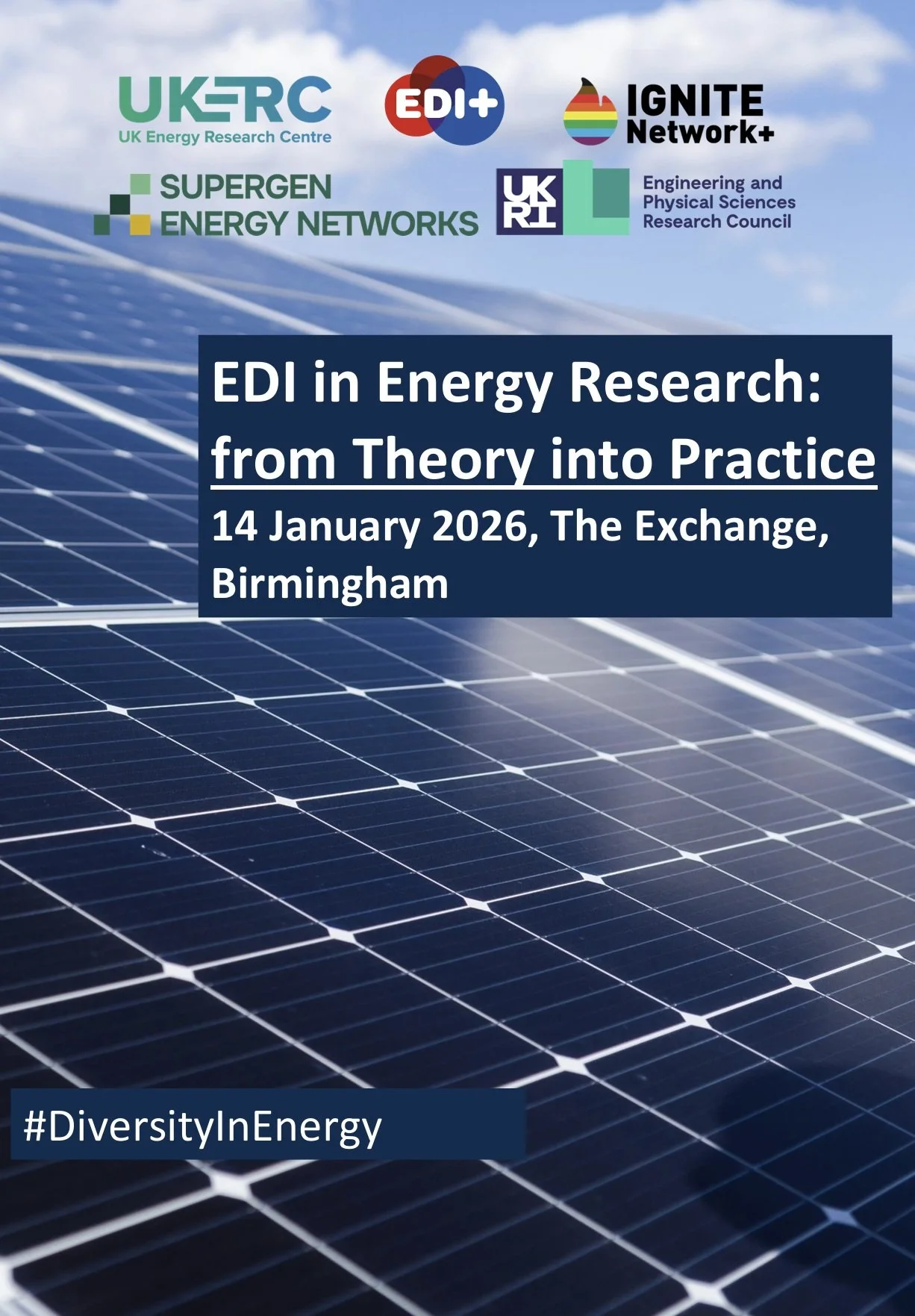
Photo Credit: ‘EDI in Energy Research’ Event Organisers
Moving Beyond ‘EDI Matters’
This one-day event blended presentations, panel discussions, personal accounts, and café-style conversations. Discussions quickly moved beyond the well‑known assertion that ‘EDI matters’ and instead explored what universities and energy organisations are actively doing to embed EDI, how research cultures are being challenged, and which changes are needed to transform practice.
Opening the day, Professor Simone Abram (Director of EDI+ and Executive Director of the Durham Energy Institute) provided a clear provocation: EDI is not an optional add-on to ‘real’ research. Rather, EDI is fundamental to research quality and outcomes. When certain voices are marginalised, Professor Abram noted, blind spots emerge, groupthink becomes entrenched, and solutions end up being designed for an imaginary ‘average’ person rather than the diverse realities of society.
EDI Efforts in a Challenging Landscape
Across the sessions, speakers acknowledged the increasingly challenging environment for EDI works as inclusion efforts become more politicised or are deprioritised under budget pressures. Yet, the rapid pace of the energy transition makes diverse perspectives more important than ever. Energy systems are deeply social and political as much as they are economic and technical, and achieving net zero depends on drawing on a wide range of experiences, insights, and forms of knowledge.
Apprenticeships, Barriers and Belonging
Dr Stewart Beattie, Senior Teaching Fellow and Associate Dean at the University of Strathclyde, presented findings from survey and focus group discussions with civil engineering students that examined apprenticeship programmes within university. His study showed that although apprenticeships are often described as widening participation pathways, they continue to be shaped by classed and gendered expectations. He noted that family and social networks influence awareness of apprenticeship opportunities, while factors such as cost of living, commuting distances, and confidence affect access. Workplace cultures, facilities, equipment design also play a role in shaping whether individuals feel they belong. Dr Beattie emphasised that widening participation efforts need to go beyond recruitment to ensure that conditions are fair, supportive, and sustainable. For example, women participants in focus group discussions highlighted that caring responsibilities were often better accommodated in workplaces than in universities, where rigid teaching schedules and inflexible deadlines are common. His reflections pointed to the need for systemic change rather than a narrow focus on increasing participation numbers.
Personal Perspectives and Lived Experience
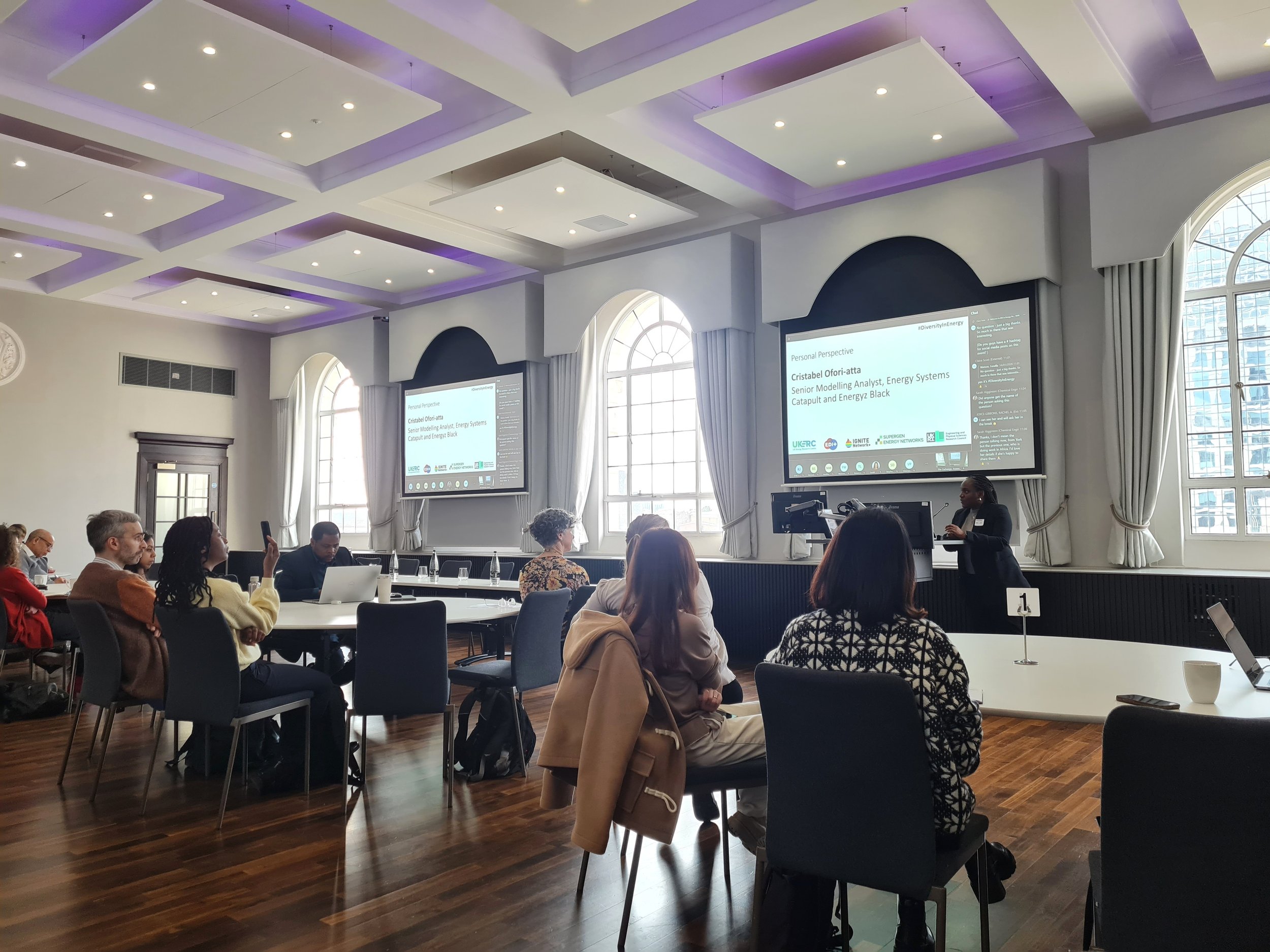
Speaker Cristabel Ofori‑Atta sharing experiences of working as an engineer in both West Africa and the UK. Photo credit: Sangita Thebe Limbu
The event also created space for personal reflections from women working in the energy sector, highlighting the often invisible work involved in navigating bias and structural barriers.
Cristabel Ofori‑Atta, Senior Modelling Analyst at Energy Systems Catapult and a member of Energyz Black, spoke about her engineering experiences in both West Africa and the UK, noting that ‘isolation is not accidental, but structural.’ She emphasised the importance of recognising lived experience as a valuable source of insight rather than regarding it as bias, and suggested that meaningful inclusion requires examining who is present, who is absent and the reasons for this, rather than simply creating additional EDI committees.
Dr Neha Chandarana, from the IGNITE Network+ and the University of Bristol, also shared reflections on her academic journey, highlighting the importance of persistence, seeking support and actively requesting feedback where possible.
Dr Natalia Zografou-Barredo, from the School of Engineering at Newcastle University, also shared her academic journey and her secondment experiences at Ofgem (Great Britain’s energy regulator) emphasising the importance of building networks and collaborations both within and beyond academia.
Café Conversations: From Intersectionality to Allyship
The café‑style conversation stations further provided opportunities for participants to engage in focused discussions. Topics ranged from coaching and mentoring, support for neurodivergent energy researchers, barriers experienced by LGBTQ+ researchers in STEM, inclusive academic pathways for non‑traditional students, forms of allyship and the practical challenges involved in leading EDI initiatives.
These conversations highlighted shared concerns across different groups as well as emerging ideas for addressing these issues in more effective and intersectional ways.
Data, Leadership and Organisational Change
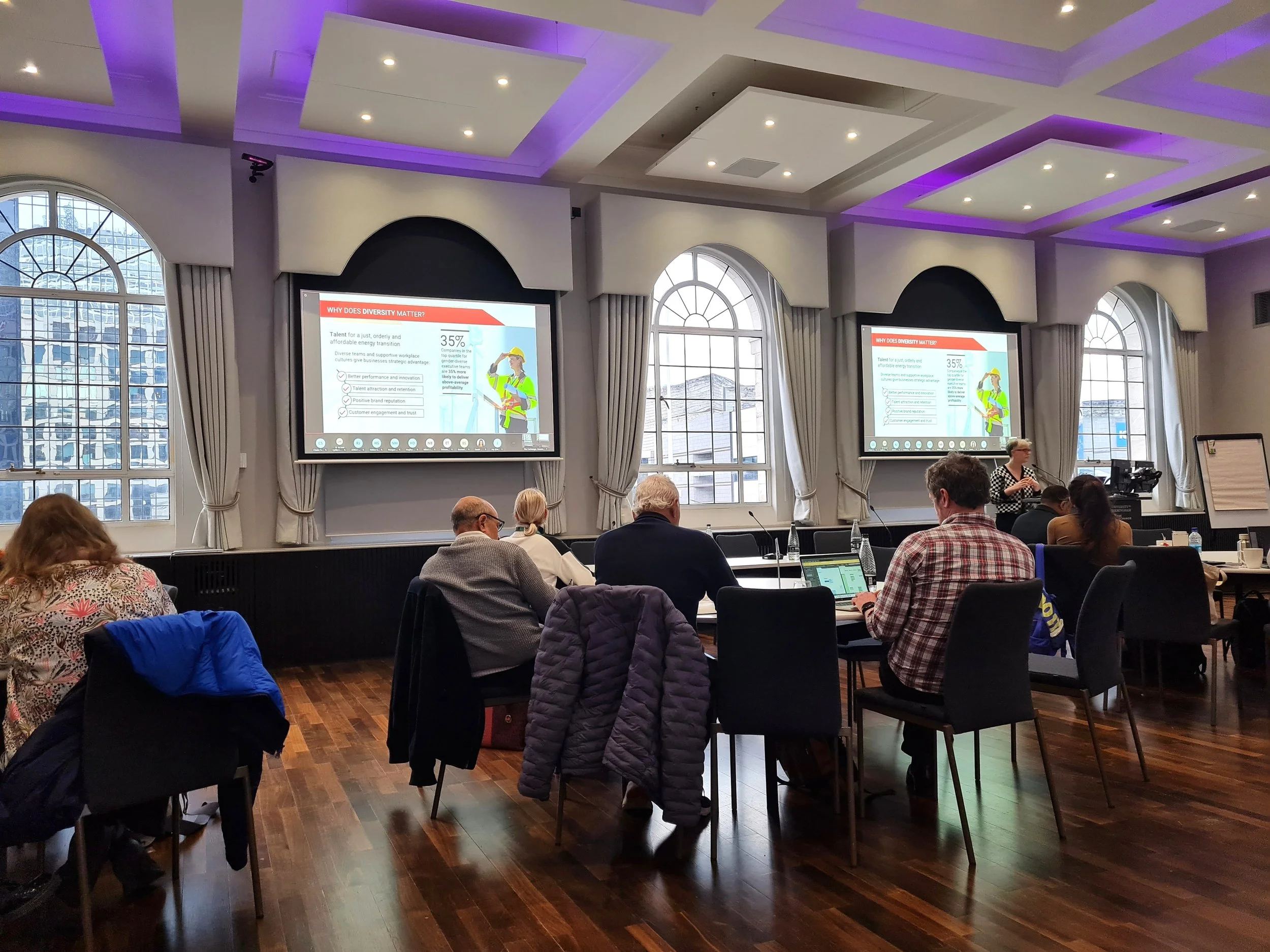
Speaker Georgina Worrall presenting on the shifting landscape of EDI in the UK’s energy sector. Photo credit: Sangita Thebe Limbu
Another session was led by Georgina Worrall, Head of POWERful Women, a professional initiative based at the Energy Institute that focuses on addressing the underrepresentation of women in senior roles within the UK energy sector. She explained how a combination of reliable workforce data and practical organisational measures can help create more inclusive workplaces.
Drawing on examples from organisations such as Good Energy, EDF and SSE, she outlined how structured recruitment processes, balanced shortlists, mixed interview panels, bias training, return-to-work coaching, and transparent data practices can build trust and support measurable progress. She also emphasised that gender inclusion should be a core part of organisational development, especially as the energy sector works to meet net-zero commitments while navigating ongoing economic pressures.
Georgina highlighted POWERful Women’s three-part approach of challenge, support, and connect, and its sector-wide ambition to reach 40 percent women in leadership and management roles by 2030. This target is supported by practical mechanisms such as mentoring, networking sessions, and career coaching.
Tools for Inclusive Cultures: Principled Spaces & Reverse Mentoring
Two conceptual tools introduced during the event offered practical approaches for strengthening inclusive research cultures. The first was the idea of principled spaces, which acknowledges that absolute safety cannot be guaranteed but suggests that shared expectations around respect, behaviour, and accountability can support constructive and challenging conversations.
The second was reverse mentoring, a practice in which senior leaders learn directly from the lived experiences of individuals from under‑represented groups, providing opportunities to identify and address blind spots that might otherwise go unrecognised.
Building Inclusive Research Cultures
The final panel discussion of the day focused on inclusive research cultures and invited participants to consider how opportunities are distributed, whether individuals feel a sense of belonging, and what it might look like for everyone to bring their full selves to their work. The panellists highlighted several persistent structural barriers within STEM and academia, including precarious employment contracts, unequal access to funding, limited transparency in promotion processes, among others. They also emphasised that EDI is not optional but a legal obligation supported by frameworks such as the UK Equality Act.
The discussion also offered a range of practical strategies to address the status quo such as aligning institutional engagement on EDI with clear action and accountability measures, using inclusive language in job descriptions, recognising, valuing, and rewarding the often invisible EDI labour undertaken by staff, establishing transparent criteria for career progression, and adopting mixed interview panels. Collectively, those discussions highlighted that creating inclusive research environments requires sustained commitment, accountability and funding, critical reflection, and broader institutional change.
Key Takeaways
EDI as foundational to quality research - Embedding equality, diversity, and inclusion (EDI) within energy research is not simply a moral or legal imperative but a foundational requirement for producing high‑quality, socially responsive, and impactful knowledge.
Conditions for Inclusive Research Cultures - Creating inclusive research cultures require sustained organisational commitment, transparent accountability mechanisms, and approaches that acknowledge and recognise how different lived experiences and structural conditions shape participation, engagement, and a sense of belonging.
Systemic, not isolated, change - EDI cannot be advanced through isolated initiatives or by relying on the goodwill and voluntary labour of individuals who already shoulder disproportionate responsibilities. Instead, meaningful progress requires integrating inclusive practices into core systems, from recruitment, job security, workplace culture to research design, funding, career progression, leadership development, and sector-wide targets and accountability measures.
Relevance for JustGESI - The event reaffirmed the importance of centering justice, representation, lived experiences, and institutional change within energy transition research, while strengthening collaborations for equitable energy futures. As the energy sector continues to navigate rapid technological, economic, social, and environmental changes, building inclusive research environments will be essential to ensuring that energy solutions are effective, just, and grounded in the needs and realities of diverse communities.
