
Written by @TaTEDO SESO, JustGESI partner
In the green villages on the lower slopes of Mount Kilimanjaro, many homes now have a meter on the wall and a bulb in the ceiling. In the kitchen, though, the three-stone fireplace still rules. In July 2026, TaTEDO-SESO conducted a baseline study under the activities of Work Package 1 of the JustGESI project, covering five villages in Moshi Rural and Rombo districts. These are Mawanjeni, Lole, Mengeni Kitasha, Mamsera Juu and Mamsera Kati. In all five, 75–80% of households cook mainly with firewood. Electricity accounts for just 0.5–4% of the cooking energy used. The five villages consist of 3,750 households. Many of them are already connected to the national grid, but they use electricity only for lighting, phone charging, radio, and television. The project sees its biggest opportunity in that gap between having a connection and cooking with it.
JustGESI exists to make sure the shift to electric cooking (eCooking) does not pass and leave behind the people who need it most: women, people with disabilities (PwDs), the elderly and the poorest of the poor. Kilimanjaro was chosen to pilot the project's Seed Fund for four reasons: its relatively high electrification rates, active women's groups, a growing eCooking market and strong community organisations.
Sources of information from grassroots
Over two weeks in July, the project team worked with Community Development Officers from both district councils. Together they introduced the project at district, ward and village levels. The team also held focus group discussions with six Village Community Banks (VICOBAs). They met village leaders, teachers, religious leaders, health and agricultural staff, and village environment committees. They also consulted SHIVYAWATA, the regional umbrella body for 12 organisations of people with disabilities. Finally, they visited 25 households: 18 people living with a wide range of disabilities, and 7 of the poorest households in the villages.
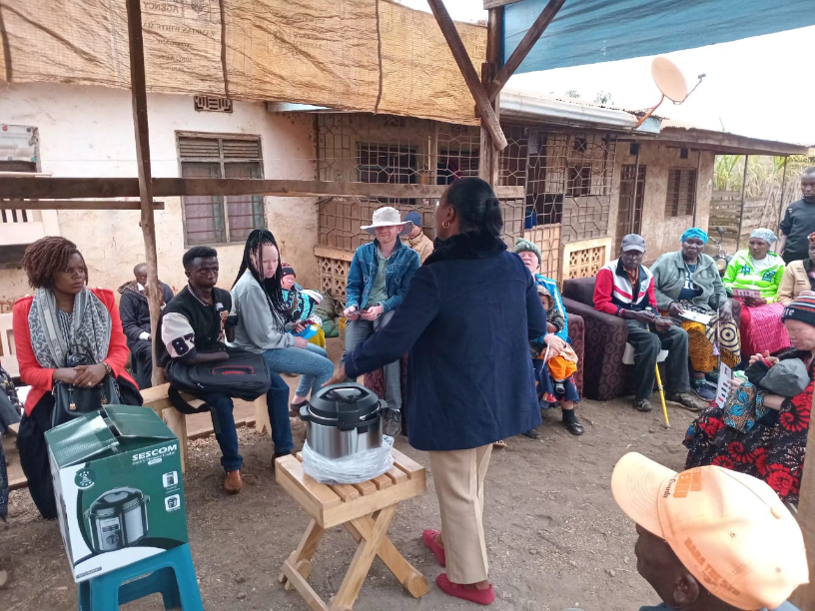
The meeting with People with disabilities in the Rombo District
Who carries the burden?
The cost of firewood is not counted only in shillings. Women typically spend two to three hours collecting firewood and another two and a half hours cooking with it. Some households reported up to 21 hours a week spent gathering fuel.
Community leaders described chest and eye problems caused by smoke and burns among young children playing near open fires. Women and children are threatened by snakes and other dangers on the way to collect biomass fuels. Firewood is harder to find in the rainy season. District councils have also banned collection from the nearby Kilimanjaro National Park (KINAPA) forest to reduce deforestation.
For people with disabilities, the challenges are sharper. Two-thirds of those interviewed (12 of 18) cook mainly with firewood. One man with a visual impairment described the risk of getting lost or meeting snakes while collecting wood, and of burning his hands while preparing it. Others spoke of falling in the kitchen, bending over fires set on the floor, and eating undercooked food when the firewood is wet. Many depend entirely on caregivers, and when caregivers are away at work or school, meals are skipped. Of the eight people with physical disabilities interviewed, only two had kitchens suited to their needs, and one could not reach the electrical socket.
The poorest households face their own squeeze. Most live on less than TZS 50,000 a month. They spend TZS 10,000–22,000 a month on firewood yet pay as little as TZS 2,000–10,000 for electricity that they use mostly for lighting.

A meeting undertaken with the Village Community Bank in Moshi Rural District
Strong interest, one big barrier
Despite these hardships, interest in electric cooking is strong. Respondents described Electric Pressure Cookers (EPCs) as safe, smoke-free, and fast, and said they preserve the taste of food. Some named a less obvious benefit: when cooking becomes simple and clean, men are more willing to share it.
SHIVYAWATA confirmed that EPCs suit people with physical disabilities because they are safe and easy to use. The problem is price. Every group consulted named the appliance's upfront cost as the main barrier. Limited awareness, power cuts, and a belief that electricity is too expensive for cooking followed close behind.
That belief deserves a challenge. As the study notes, a household spending TZS 10,000 on firewood could instead buy more than 100 units of electricity. With an efficient EPC, that is enough for several days of cooking. The real hurdle is the lump sum needed to buy the cooker, not the monthly bill.
Village Community Banks (VICOBAs) ready to lead
One of the study's most encouraging findings concerns the VICOBAs. The six groups consulted are well organised. Each is governed by a constitution, elects its leaders democratically, keeps a bank account and ledgers, and reports good loan repayment.
Several already finance EPCs for their members. Twaweza in Mamsera Juu offers six-month instalment plans, and Bande A in Mamsera Kati offers three-month instalment plans. In Mawanjeni, Karango A members have bought EPCs with group loans and repaid them in full.
Members are keen to become eCooking champions, and they have already named the channels they would use should they be selected to become partners in the project: village meetings, churches and mosques, schools, markets and door-to-door visits. They have also named what they need: live EPC demonstration training, marketing and customer-service skills, reliable local stock and after-sales support.
One gap stands out. Some villagers believed eCooking was only for VICOBA members, and most people with disabilities and the poorest households are not members. Twaweza itself asked for a way to extend EPC loans to non-members. Closing this gap is central to how the fund is designed.
What Inclusion is Required in Practice
The study is clear that handing someone a cooker is not enough. Its recommendations focus on what makes eCooking usable and lasting:
Targeted subsidy. The most vulnerable households would receive more than 50% of the cost of an EPC. They would make a small contribution and pay the balance in instalments.
Accessible appliances and kitchens. This means tactile-dot EPCs for blind users, lowered sockets, kitchen switches and wiring, and simple adaptive tools.
Training for two. People with disabilities and their caregivers would be trained together, using materials in simple Swahili, large print, audio, and sign language.
Demonstrations with local food. Neighbours would watch beans, bananas, rice, maize and meat being cooked, and see for themselves the time saved, the electricity used and how safe it is.
After-sales care. Trained local technicians, spare parts, warranty information and a small maintenance reserve would keep cookers working.
Beneficiaries will be chosen through a transparent, community-led process. Criteria will be published. Village leaders, social welfare officers and SHIVYAWATA will verify households, including through household visits. The list will then be displayed publicly so the community can raise concerns before it is approved. SHIVYAWATA also stressed respectful language and the involvement of organisations of people with disabilities at every stage
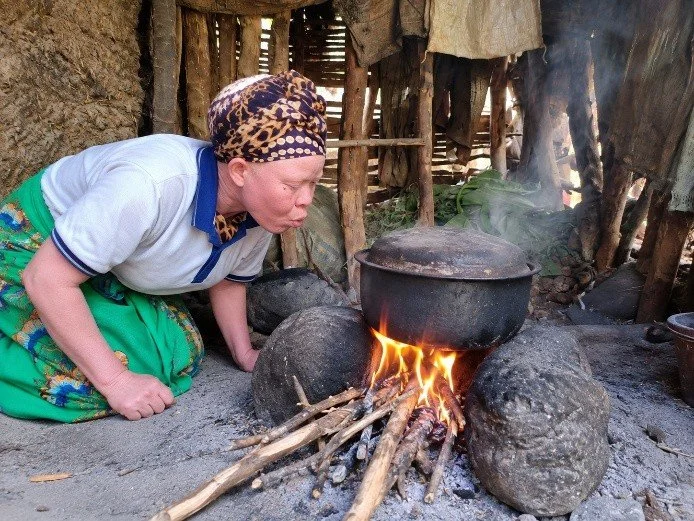
Typical kitchen with a three-stone fireplace for a household of the people with disability in Rombo District
A Fund is designed to revolve
To outlive the project, the Seed Fund will operate through the partner VICOBAs as a revolving fund: as early buyers repay, their payments finance the next household. TaTEDO-SESO's Moshi office, local government, the VICOBAs, and community representatives will monitor it together. They will track not only how many cookers are distributed but also whether people are actually using them.
The fund is built as targeted equity support, not equal distribution. Those facing the greatest economic, social or disability-related barriers will receive enough help to take part.
What aspired as the way forward
Village leaders have pledged to mobilise communities, verify eligible households, and promote clean cooking through meetings, churches, schools and markets. Local radio stations such as Kicheko FM, Sauti ya Injili and Radio Banana were identified as media that will carry the message further. The first proposed beneficiaries are people with disabilities who can cook with the right support, and poor households ready to contribute through instalments.
If the Kilimanjaro pilot succeeds, it will offer Tanzania a practical model for a clean cooking transition that finally brings the grid to the kitchen. In that model, the people who bore the heaviest burden of the old way of cooking benefit first from the seed fund.
