Policy Dialogue Roundtable on Women’s Advocacy Priorities in Ethiopia’s Informal Energy Sector
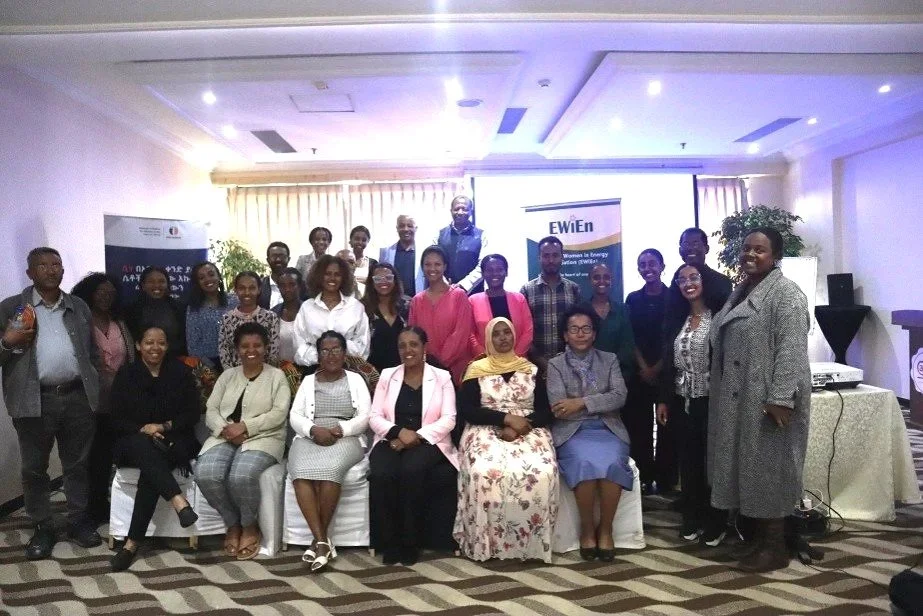
Group photo from the ‘Policy Dialogue Roundtable on Women’s Advocacy Priorities in Ethiopia’s Informal Energy Sector’ in Addis Ababa.
On 26 March 2026, JustGESI team members Dr Guday Emirie and Dr Getachew Bekele, both from Addis Ababa University, participated in a policy dialogue roundtable on women’s advocacy priorities in Ethiopia’s informal energy sector in Addis Ababa. The event was hosted by Ethiopian Women in Energy (EWiEn) in collaboration with the Strategic Initiative for Women in the Horn of Africa (SIHA) Network.
The roundtable brought together representatives from key government institutions, including the Ministry of Water and Energy, Ethiopian Electric Power, and the Ministry of Women and Social Affairs, alongside civil society organisations and NGOs such as EWiEn, GIZ Ethiopia, Care Ethiopia and ADRA. Participants also included energy cooperatives, private sector actors and educational institutions, including TVET and Addis Ababa University. The purpose of the event was to present advocacy priorities and identify pathways for integrating women’s contributions into local economic policies, with particular attention to labour protections, property rights, and access to resources.
Members of the national Gender and Energy Technical Working Group (GE-TWG), including the JustGESI Work Package 2 team members Dr Getachew Bekele and Dr Guday Emirie, took an active role in the discussions. The GE-TWG is a national initiative established by the Ministry of Water and Energy to ensure that gender equality is integrated into Ethiopia’s energy sector.
The policy dialogue aimed to identify urgent policy changes and institutional pathways that can transform women’s participation in the informal energy sector from survival-based work into empowered, policy-recognised economic engagement.
The policy dialogue opened with remarks from an EWiEn representative, followed by a presentation on ‘Women’s Advocacy Priorities in Ethiopia’s Informal Energy Sector’ delivered by the founder and managing director of ON Energy Consult and co-founder of EWiEn. This was followed by an interactive roundtable discussion where participants addressed two key questions: what policy change is most urgent? And what actions can institutions take to support these priorities?
Key takeaways from discussions:
During the presentation and discussion sessions, the following key points were highlighted:
The informal energy sector (IES) in Ethiopia - largely unrecognised and unregulated traditional energy economic activities - provides essential energy services (including mainly biomass traders) to a significant proportion of the population in a decentralised and often inefficient distribution due to the absence of official infrastructure in many areas.
Biomass is the major energy source in Ethiopia where only 44% of the population access a basic level of electricity service (Tier 1 and above). Over 92% of households, 70% of industries and 94% of service enterprises use biomass as energy source for cooking, posing serious risks to health, gender equality and forest preservation and economic productivity.
Women are powering Ethiopia’s informal energy economy. Women are not only energy users, but also major suppliers of traditional fuels in Ethiopia. They are dominant in last-mile energy distribution, but face exclusion from labour protections, property rights, and access to resources.
More than two-thirds of traditional fuels are supplied by poor urban and rural women in Addis Ababa. Women are engaged in low-profit energy business-economic sectors that limit their access to high value markets. Educational level of entrepreneur positively correlates with the economic achievement. However, women show lower literacy level (44% of women are literate against 59% of men).
From last-mile distribution to supplying the majority of traditional fuels, women are sustaining communities while navigating barriers in finance, recognition, technology, and policy. They are economically active, yet systemically excluded. Through powerful insights and real experiences, including the story of Aster of Amarech Energy Technology Enterprise, one thing became clear: ‘invisibility is not absence. It’s a policy system design gap.’
The policy dialogue roundtable discussion further highlighted the following points related to advocacy priorities and stakeholders’ role:
1) Advocacy priorities:
Recognition: Recognition of women’s informal energy economic activities and formally incorporating women’s contributions into the national energy policy.
Labour protections: Ensuring protection of basic labour standards (including safe working conditions) and certification pathways.
Property rights: Securing access to land, cooperatives and business registration; and reforming cooperative’s criteria, joint ownership, and legal support to strengthen women’s economic position.
Removing barriers to access to resources: Expanding access to gender-targeted finance, training, and clean energy technologies.
Finally, the above advocacy priorities need to be backed by institutional commitments to resource access and capacity building.
2) Institutional Roles/Pathways:
Government: Design inclusive policy to transform the lives of women in the informal energy sector by protecting labour rights, securing property ownership, and expanding access to resources.
Energy Cooperatives: Provide trainings, organise women-led groups, advocate for fair market access.
Civil Society Organisations: Mobilise grassroots advocacy, document women’s experiences, push for accountability in policy implementation.
NGOs: Provide financial and technical support
Private Sector: Invest in inclusive clean energy technologies, expand microfinance.
Academia: Advance research on gender-energy linkages and policy analysis.
GE‑TWG: Coordinate multi-sector effort, monitor gender mainstreaming, empower women as key stakeholders in Ethiopia’s energy and economic policies and develop measurable indicators for accountability.
Finally, in her closing remarks, the EWiEn representative thanked all participants (stakeholders) for their contributions in moving the policy dialogue forward by identifying advocacy priorities and institutional responsibilities for formalising women’s contributions in the informal energy sector.
