
Written by Dr Serena Saligari and Dr Harshit Vallecha, JustGESI
On 1st October 2026, colleagues from across the UK Research and Innovation (UKRI) Ayrton Fund Challenge portfolio gathered at the University of Warwick for the Ayrton Sister Projects Networking Meeting. Bringing together researchers working on clean energy access, community energy, circular technologies, productive uses of energy, solar manufacturing and gender equality and social inclusion (GESI), the meeting provided an opportunity to exchange experiences and consider how research can deliver lasting change beyond the lifetime of individual projects.
For JustGESI, which works to mainstream GESI in just energy transitions across Ethiopia, Malawi, Mozambique and Tanzania, these conversations raised an important question: how can clean energy initiatives build the local capacities and inclusive institutions needed to ensure that their benefits endure?
From Delivering Technologies to Building Lasting Capacity
The day opened with discussions on knowledge transfer and sharing, highlighting the importance of developing expertise that remains available locally long after project funding ends. Professor Giuliana Battisti, Deputy Co-Lead of CEPREC, explored how technical innovation can be connected with behavioural insights, policy engagement and capacity building. One example was the reuse of second-hand batteries in microgrids, drawing on available materials and local labour to create affordable energy systems while considering how materials might be recovered and reused at the end of their lives.
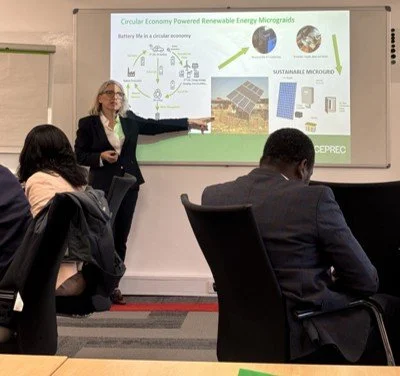
Presentation from Professor Giuliana Battisti outlining the circular economy of batteries in minigrids. (Photo Credit: Serena Saligari)
This emphasis on sustainability extended to the work of African SCENe, presented by Dr Jordan Lafayette and Dr George Foden. Their project explores a business model that transforms schools in informal settlements in Nairobi into community energy hubs. Solar generation and storage can support school activities while enabling additional services, including laundry, water pumping, baking and access to electric pressure cookers. Revenue from these activities can help schools repay loans and support their continued development.
The example demonstrated how community energy systems can be designed around locally identified needs and multiple productive uses, rather than electricity generation alone. It also highlighted the importance of co-creation: working with communities to establish what services are needed and developing impact measures that reflect local priorities. As the discussion illustrated, creating opportunities for participation requires attention to whose voices are heard and whose experiences inform project design.
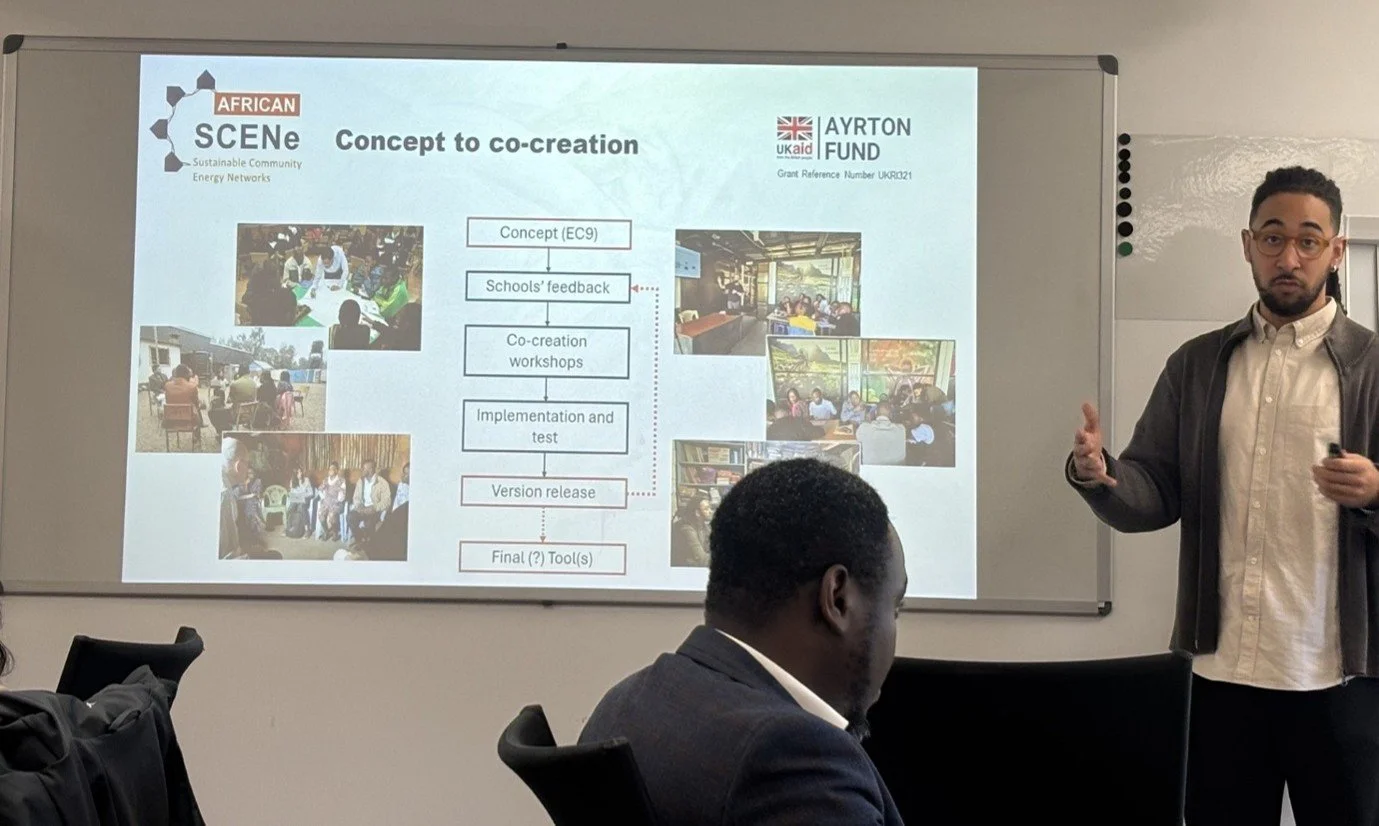
Presentation from Dr Jordan Lafayette outlining the co-creation process underpinning the creation of schools’ community energy hubs. (Photo Credit: Serena Saligari).
Addressing GESI barriers in Energy and Engineering Education for a Just Energy Transition in Africa
Our team member Dr Harshit Vallecha from Sheffield Hallam University presented JustGESI's work on addressing GESI barriers in energy and engineering education for a just energy transition in Africa. The presentation highlighted that achieving a just transition requires not only the deployment of clean energy technologies, but also greater attention to who can access the skills, educational opportunities and professional pathways associated with the transition. Drawing on empirical evidence from Ethiopia, Malawi, Mozambique and Tanzania, the presentation examined the social, cultural and institutional barriers that continue to limit participation of women and marginalised individuals in engineering and energy-related sectors. Through ongoing surveys of students and Focus Group Discussions with educational professionals at partner institutions in four countries, the presentation discussed how systemic barriers shape access to engineering education and future employment opportunities in the energy sector. It outlined strategies for fostering more inclusive education systems and labour markets, ensuring that the benefits of the energy transition are shared more equitably. The presentation also outlined the strategy to train 270 women technicians in Solar PV system design, installation and ecooking technologies across the four countries. This is the part of JustGESI project’s initiative to build technical capacity of underrepresented individuals and addressing GESI skill gaps in energy education and workforce.
These questions were reflected in discussions throughout the meeting. The development of community energy systems, for instance, depends not only on technical performance but also on whether local people can participate in their design, management and economic opportunities. The African SCENe discussion highlighted the value of community-based connectors who understand local contexts, as well as the difficulties that can arise when community representatives do not feel confident contributing to consultations.
For JustGESI, these experiences reinforce the need to treat inclusion as part of how energy initiatives are conceived and implemented, rather than an additional consideration addressed after technical decisions have been made. Who participates, whose knowledge counts and who benefits from new energy opportunities are central questions for a just transition.
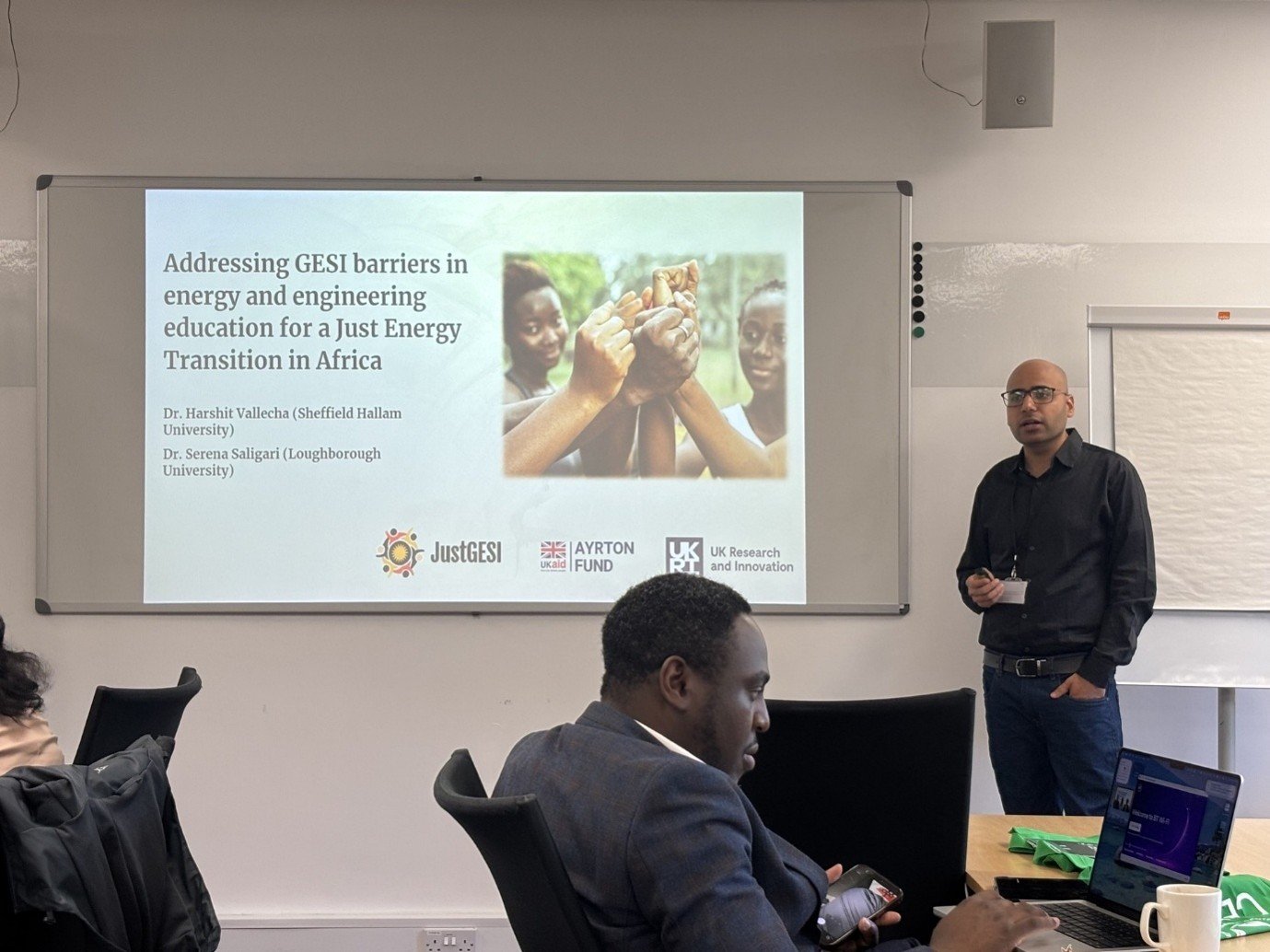
Presentation from Dr Harshit Vallecha on barriers to energy and engineering education. (Photo Credit: Serena Saligari)
Designing Energy Systems Around How People Use Energy
The afternoon workshops and project presentations further demonstrated the importance of connecting technical modelling with everyday energy needs.
Dr Benedict Winchester introduced CLOVER, an open-source model for optimising community-scale energy systems and minigrids over their lifetimes. Discussions highlighted the need to account for changing and flexible electricity demand, including demand associated with electric cooking. Without adequate consideration of how and when electricity will be used, minigrids may struggle to support the services communities need. Combining modelling with qualitative assessments of community energy use can therefore help produce more realistic system designs.
Other presentations explored how to make better use of existing infrastructure. Dr Shishank Shishank from SMART-SIP+ examined opportunities to generate revenue from surplus solar electricity through productive uses such as food and cold storage. Meanwhile, Professor Suresh Perinpanayagam from the CREDiT project highlighted the difficulties facing minigrids when local repair and maintenance capacity, spare-parts supply chains, revenue collection and accountability are insufficient.
The REACH-PSM presentation led by Chantal Bideleux and Panos Chatziangelakis extended this discussion to sustainable solar manufacturing, emphasising the role of research, capacity building and international collaboration in developing longer-term capabilities.
The message was clear: installing infrastructure is only one part of the work. Energy systems must also be supported by the skills, governance arrangements, financial resources and local economic opportunities required to keep them functioning.
Building a Collective Legacy
The meeting concluded with a workshop on collective impact chaired by Dr Charlotte Ray and Dr Joe Butchers from the SHINE project, which brought team members together to identify opportunities for shared learning, collaboration and work beyond the Ayrton Challenge funding period.
A common theme emerged: sustainable energy transitions depend on relationships between researchers, communities, industry and government; locally grounded knowledge; opportunities for meaningful participation; and the institutional and economic capacities to sustain change. The workshop also provided a valuable opportunity to strengthen collaboration across the sister projects, creating space for researchers working in different contexts to exchange experiences, identify shared challenges, and explore opportunities for joint learning and future collaboration. In particular, the event highlighted the importance of supporting early career researchers, who benefited from opportunities to present their work, receive feedback from colleagues across disciplines, and build professional networks that can foster future research partnerships. Dr. Jordon Lafayette from African SCENe project collated the contact details of ECRs engaged in Ayrton Challenge projects and efforts are underway to establish a UKRI Ayrton ECR Network. These exchanges reinforced the value of interdisciplinary and cross-project collaboration in generating more inclusive, context-sensitive, and impactful approaches to support just and sustainable energy transitions.
For JustGESI, these discussions provide valuable opportunities to connect GESI considerations with wider questions of energy-system design, capacity building and long-term implementation. They also underline why the benefits of clean energy cannot be assessed solely through the technologies deployed or the electricity generated. Attention must also be paid to who can participate in shaping these systems, who can access their benefits and whether the capacities created will endure.
We thank everyone who contributed to the meeting, particularly those involved in organising the event, for creating space for these exchanges and for strengthening connections across the Ayrton Fund portfolio.
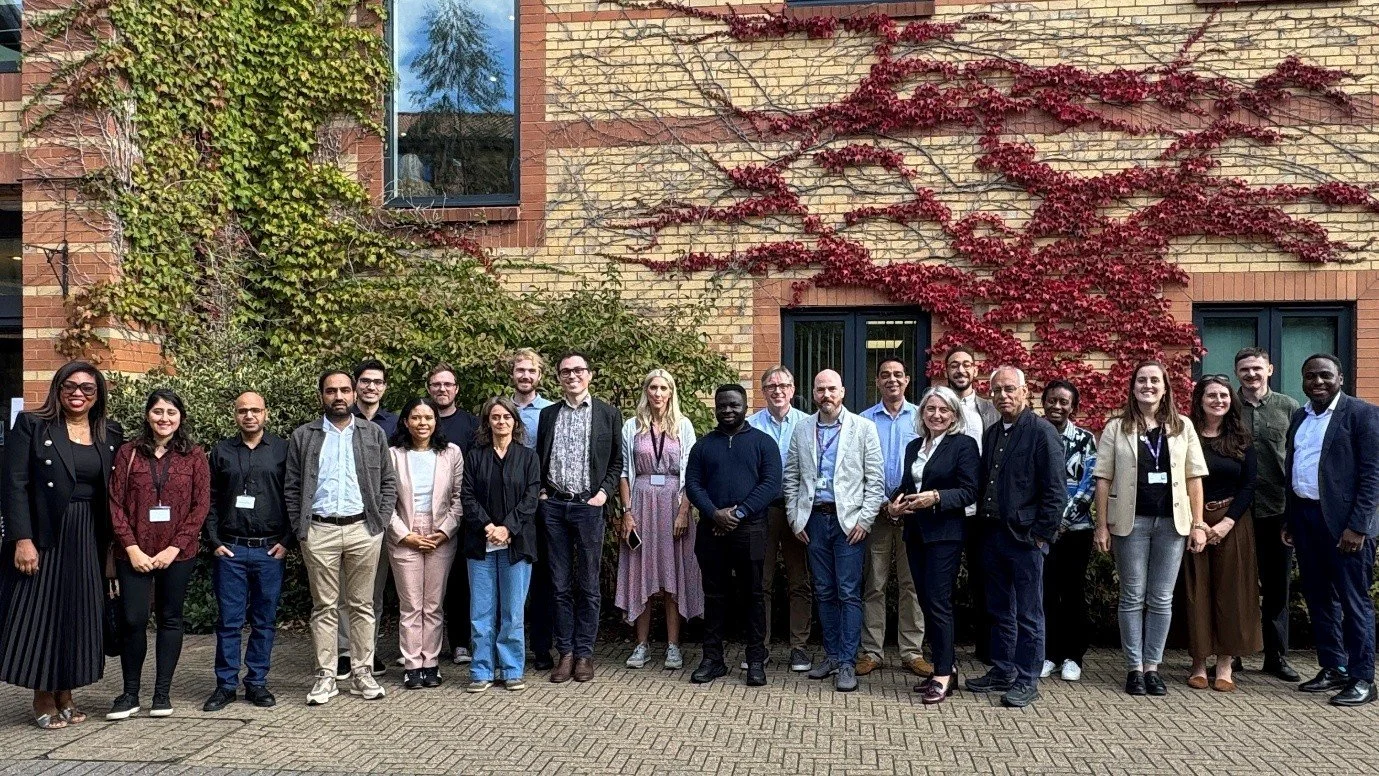
UKRI Ayrton Fund Sister Projects meeting attendees. (Photo Credit: Nitika Bhalla)
