Multilateral Action, Local Impact: Key Insights and Reflections from an Expert Panel on Inclusive Models for the Energy Transition
Written by Dr Florence Muheirwe, JustGESI Postdoctoral Researcher, Institute of Human Settlements Studies, Ardhi University, Tanzania
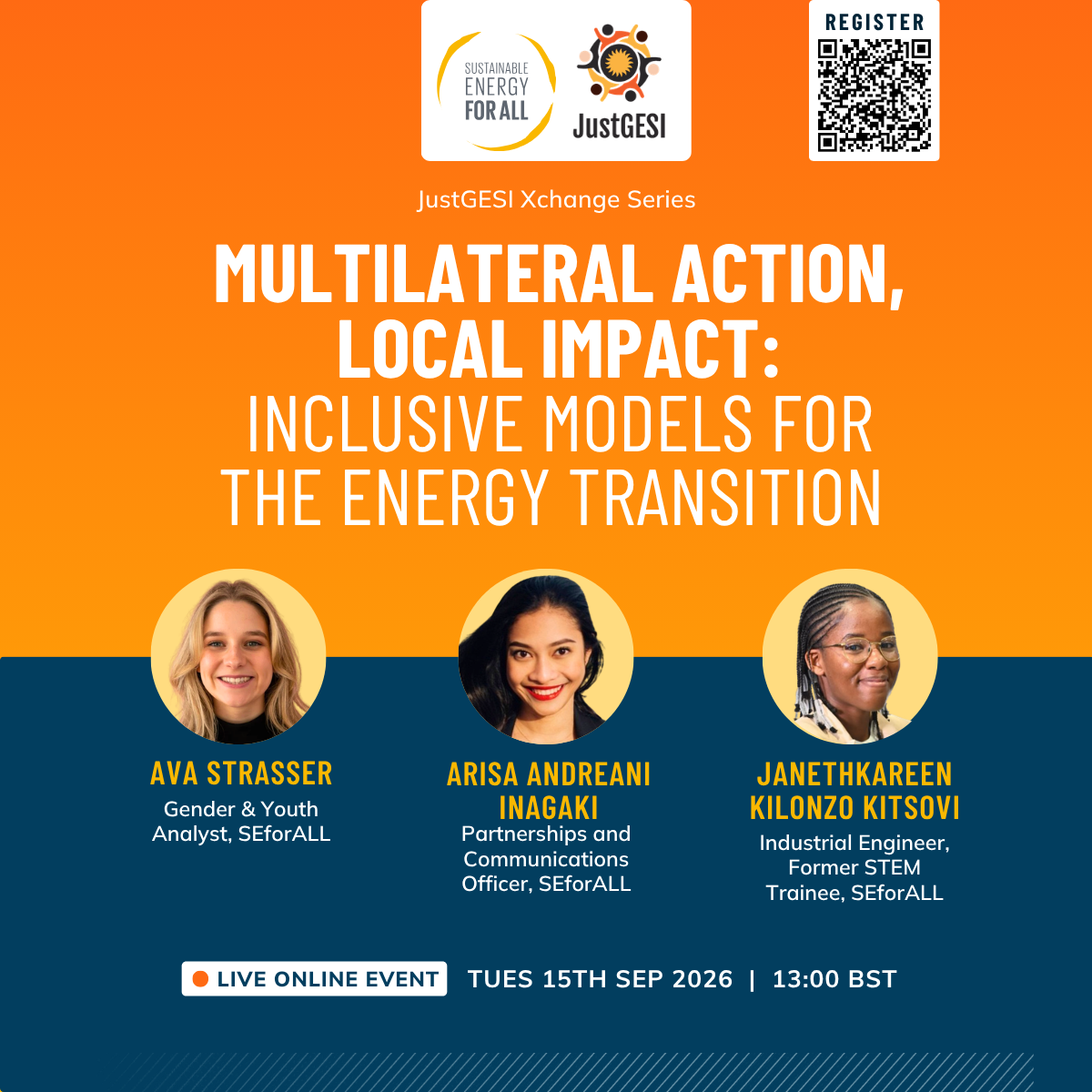
The Just Energy transition is not only about technological change but also about institutions that support inclusion, partnerships that support country-level implementation, and capability-building that addresses realistic needs. The JustGESI XChange Series hosted a webinar on September 15, 2026, bringing together participants interested in energy access and passionate about a just and inclusive energy transition. Under the theme ‘Multilateral Action, Local Impact: Inclusive Models for the Energy Transition,’ the event featured Sustainable Energy for All (SEforALL) team members Ava Strasser, Arisa Andreani Inagaki, and Janethkareen Kilonzo Kitsovi. SEforALL works at the intersection of energy, climate, and development, supporting efforts to end energy poverty by improving energy efficiency, expanding renewable energy, and advancing climate action. Their work aligns with our JustGESI objectives, and we couldn't have made a better choice for our webinar series.
The Presentations
Ava Strasser's presentation addressed the global state of energy poverty, emerging opportunities, and systemic barriers within energy ecosystems. She connected United Nations frameworks with SEforALL’s initiatives, particularly its commitment to ‘leave no one behind’. The session highlighted energy's role in transforming economies, especially in developing countries, and its designation as Sustainable Development Goal 7. Ava also emphasized gender- and youth-focused programs, including support for female engineers and academics to strengthen women's capacity to pursue opportunities and leadership roles in the energy sector.
Arisa Andreani Inagaki presented on institutional partnerships and clean cooking in schools. Her presentation examined how institutional platforms and international convening power can accelerate the transition to clean cooking in schools. Inagaki shared insights on clean-cooking platforms in schools, knowledge exchange, advocacy, and policy measures that support the adoption of clean energy and clean-cooking technologies. The presentation emphasised the importance of partnerships in connecting international advocacy with country-level implementation.
Lastly, Janethkareen Kilonzo Kitsovi shared her experience in capacity building and its community-level impact. As a former SE4ALL STEM trainee who supported Tanzania's Clean Cooking Transition in Schools initiative, Janethkareen highlighted the practical challenges involved in implementing clean cooking solutions. The session explored lessons learned, barriers to adopting electric cooking, and how capacity building connects energy initiatives with communities. These three sessions provided valuable insights and experiences, with some crosscutting ideas.
Leaving No One Behind
A just energy transition must go beyond expanding energy access. Ava emphasized that expanding access to electricity, renewable energy, and clean cooking devices is essential, but access alone does not guarantee an equitable transition. The commitment to leaving no one behind requires attention to who benefits from energy investments, who participates in decision-making, and who may remain excluded. While the global energy landscape shows progress in energy access, Strasser explained that this is not enough, as energy poverty persists and SDG 7 targets are not being met.
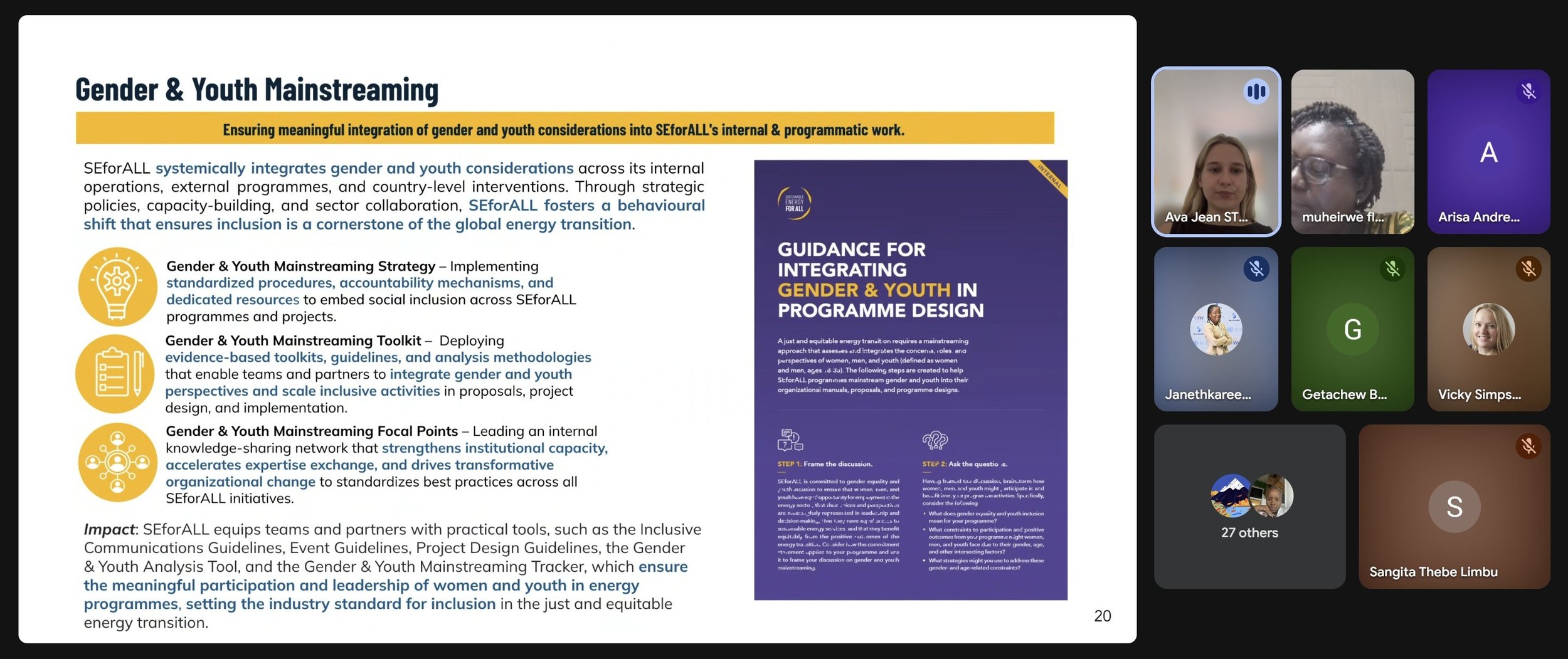
Selected slide shared by Ava Strasser during the presentation.
She called for energy policies, institutional strategies, program design, and implementation processes that integrate intersectional aspects of inclusion. This includes creating meaningful opportunities for women and young people to participate in technical professions, research, and leadership in energy-sector decision-making. In addition, energy transition policies should be assessed not only by the amount of energy delivered but also by the equity of access, participation, and benefits they produce. Building on Ava's submission on leaving no one behind, both Arisa and Janethkareen noted that clean cooking is a key dimension of a just energy transition. Focusing on clean cooking in schools highlights an important dimension of the energy transition that discussions often overlook when they concentrate primarily on electricity generation and renewable energy capacity. Transitioning schools to cleaner cooking solutions affects institutional energy use, meal-preparation conditions, and health by enabling nutritious meals and reducing pollution and its associated health effects.
Building Partnerships
International partnerships matter, but local implementation drives impact. The webinar explored the relationship among multilateral cooperation, institutional partnerships, advocacy, and country-level implementation. Ava noted that advocacy, partnerships, and platforms that meaningfully engage women and youth on SDG 7 can support energy-transition policy development, while Arisa explained that international platforms can mobilise expertise, strengthen collaboration, enable knowledge exchange, and support policy advocacy. International cooperation works best when it strengthens local institutions, responds to local realities, and facilitates sustainable implementation beyond individual projects. Platforms support a just transition, ensuring no one is left behind, and multilateral organizations can implement this transition beyond dialogue and advocacy. Arisha shared how SEforALL partnered with WFP, providing food support to schools to integrate their clean energy initiatives in Tanzania. This created a platform for clean cooking in schools, enabling healthy and nutritious meals cooked with sustainable energy technologies.
Arisa further explained that partnerships create the conditions to scale because shared knowledge and resources reduce fragmentation and duplication of efforts by giving room to a collective, stronger voice, as different partners bring different expertise; for instance, government brings national presence in policymaking processes, NGOs have local presence, while the private sector provides room for new technologies and innovation, research institutions provide evidence to support decision-making, while donors and investors provide finance for investment in infrastructure and equipment that support energy transition.
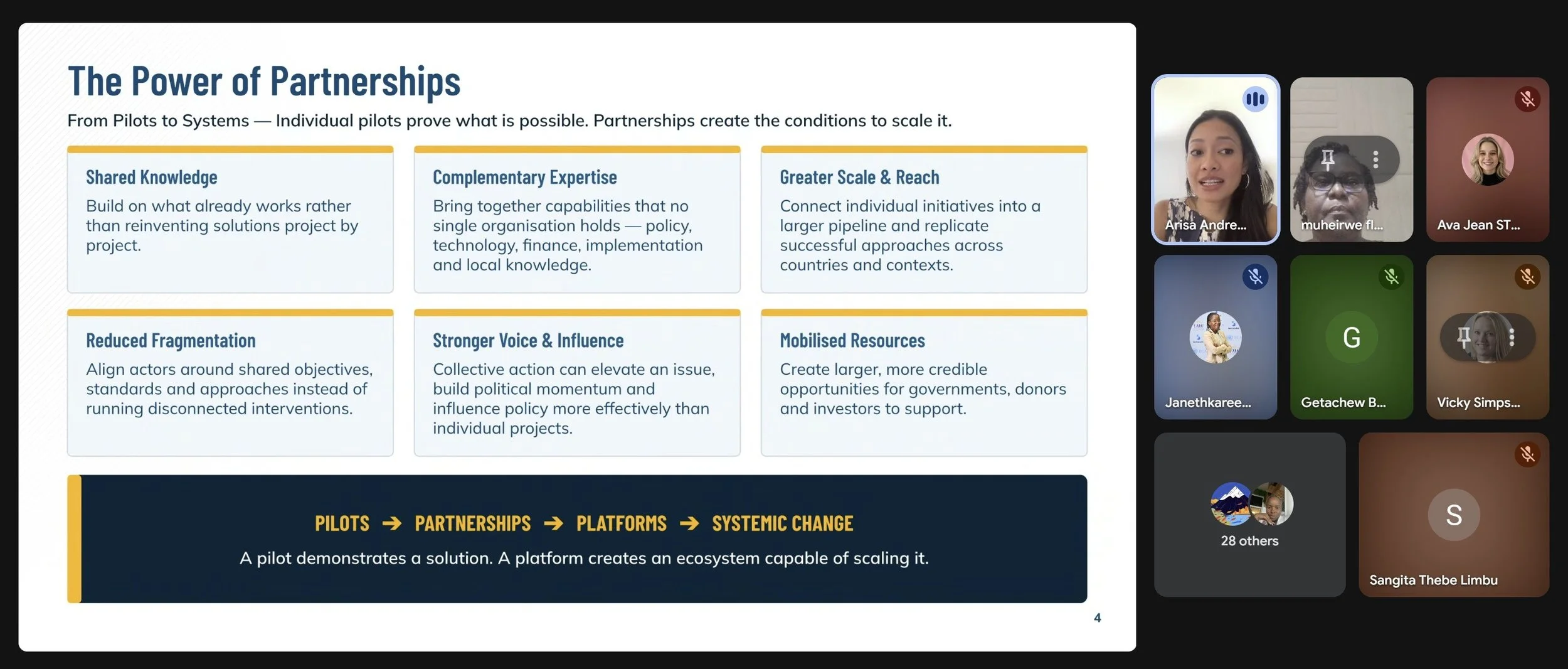
Selected slide shared by Arisa Andreani Inagaki during the presentation.
Evidence from Tanzania, as shared by Janethkareen and Arisa, confirmed that partnerships among government institutions, development partners, educational institutions, and communities can help bridge the divide between policy commitments and practical delivery. Thus, stronger cross-sector partnerships are needed to facilitate collaboration among policymakers, energy institutions, researchers, development partners, civil society, and communities, linking policy priorities with implementation realities.
Capacity Building and Policy: Enablers for Ending Energy Poverty
Speakers emphasised that the transition to clean cooking requires more than distributing technologies; it also depends on enabling policies, institutional support, appropriate infrastructure, and sustained user engagement. At SEforALL, Ava explained that the STEM Traineeship provides women and young people with training and experience to prepare them for sustainable careers in the energy sector. Capacity-building can also connect energy policy with community realities. Arisa stressed that these transitions must align with national and institutional priorities. Janethkareen's experience as a former STEM trainee illustrates how capacity-development programs can link professional growth with practical energy initiatives. These efforts aim not only to strengthen technical expertise but also to promote behavioral change, which can be a significant barrier to adopting new clean-cooking technologies. Janethkareen cited the belief that food tastes less delicious when cooked using traditional energy sources as an example of a misconception that constrained the implementation of EPCs. In the Tanzanian context, addressing this required community sensitisation to encourage adoption. Capacity-building is also important for addressing the practical conditions that influence adoption and the ability to maintain equipment, since introducing new technologies does not automatically ensure adoption or long-term use. Therefore, investing in people and local capabilities is essential to translating energy-transition ambitions into practical, lasting outcomes.
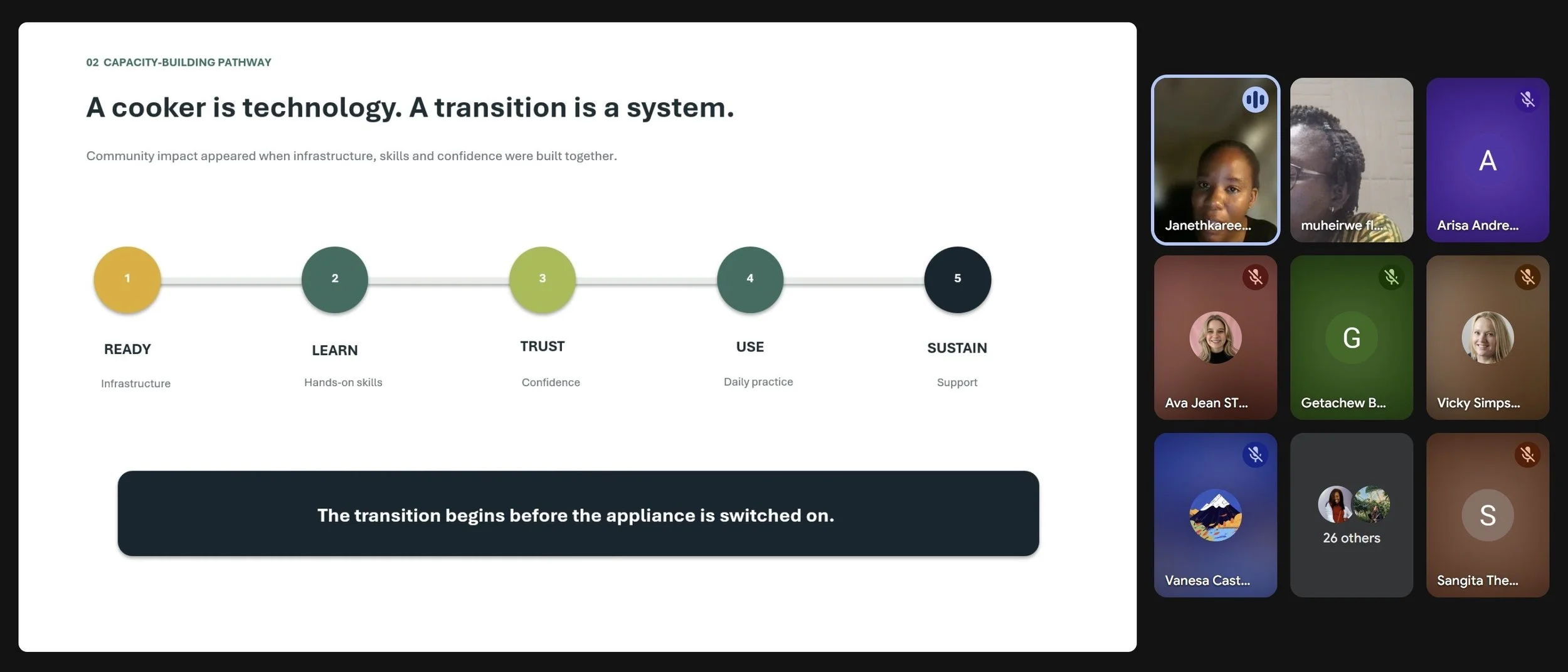
Selected slide shared by Janethkareen Kilonzo Kitsovi during the presentation.
Drawing on her experience working with schools in Tanzania, Janethkareen has learned that the transition to clean cooking requires listening to communities, equipping people and systems, and building trust through capacity-building initiatives. She summarises this approach by stating, ‘capacity building should create people who can carry the transition forward.’ Starting as a STEM trainee at SEforALL also led her to other opportunities to contribute to the energy modeling platform, green building solutions, and other initiatives.
Evidence-based Decision Making
Appropriate indicators are essential, as broad commitments to equality alone do not show whether inequalities are decreasing. Strasser noted that establishing an evidence base and compiling gender-disaggregated data supports the development of knowledge products and tools to raise awareness, facilitate information exchange, and strengthen gender-focused interventions. However, evidence and accountability should address not only access to energy but also inclusion and the distribution of benefits to achieve sustainable outcomes. Janethkareen shared practical insights based on her experience in Tanzania. Assessments and baseline surveys in schools indicated that most schools cooked outdoors. The team ran experiments with various cooking equipment to dispel misconceptions that EPCs are unsafe and use substantially more electricity. Although the transition takes time, cooking demonstrations, testing, and experiments proved effective, as evidenced by an increase in the number of students eating at school after EPCs were introduced. Tanzania's experience offers a model for clean cooking initiatives in which enabling conditions and institutional arrangements address school challenges and can be scaled up in other institutions with high energy demands. Moreover, evidence-based research supports setting clear objectives, appropriate indicators, regular monitoring, and accountability for results, helping promote and measure inclusivity. Drawing on the School Meals Coalition program, Arisa demonstrated how data informed decision-making and innovation. Because schools are the second-largest consumers of biomass after households, focusing on them enabled SEfoALL to understand the transition's benefits on a much larger scale. Importantly, the global carbon market can monitor, verify, and monetize these benefits.
Concluding Reflections
The JustGESI XChange Series seminar provided a platform for connecting global perspectives on the energy transition, institutional partnerships, gender and youth inclusion, and community-level implementation. By bringing together global strategy and local context in clean cooking partnerships in Tanzania, the event underscored the importance of addressing the energy transition as both a technical and social development challenge. In all this, the importance of policy, advocacy, international cooperation, and innovative collaboration and financing models in advancing the energy transition cannot be overstated. Accordingly, policy, financing, and partnerships must reinforce one another. Achieving sustainable and inclusive energy transitions requires alignment among policy, financing, institutional coordination, and implementation capacity. However, energy-sector institutions and development partners need to improve coordination to ensure that inclusive energy policies are supported not only by appropriate resources and clearly defined implementation responsibilities but, more importantly, by mechanisms for tracking results.
A full recording of the presentation is available through this link.
