
JustGESI Engagements in Ethiopia: Key Insights from Recent Energy Sector Events
In February this year, JustGESI team member Dr Getachew Bekele (Associate Professor at the School of Electrical and Computer Engineering, Addis Ababa University) participated in three key energy sector engagements in Ethiopia:
the Stakeholder Workshop on Electric Cooking in Humanitarian Settings
the Gender & Energy Technical Working Group (GE‑TWG) meeting
the 78th Talk Energy Ahead (TEA) session
Across these events, stakeholders from government, NGOs, research institutions, and civil society convened to explore practical pathways for advancing inclusive, sustainable, and community‑centred energy transitions. Below, Dr Getachew Bekele provides a summary of the key discussions and insights from those engagements.
Electric Cooking in Humanitarian Settings: Lessons from Sheder Refugee Camp
Hosted by Mercy Corps and the Ethiopian Clean Cooking Alliance (ECCA) on 10 February 2026, the workshop presented findings from an e‑cooking pilot powered by a 254 kWp mini‑grid in the Sheder Refugee Camp. The pilot assessed the feasibility, affordability, and user experience of various electric cooking technologies, including infrared stoves, electric pressure cookers (EPCs), and induction cookers among refugee households and small businesses in the Somali region.
Participants explored opportunities and challenges for scaling electric cooking in humanitarian and underserved areas.
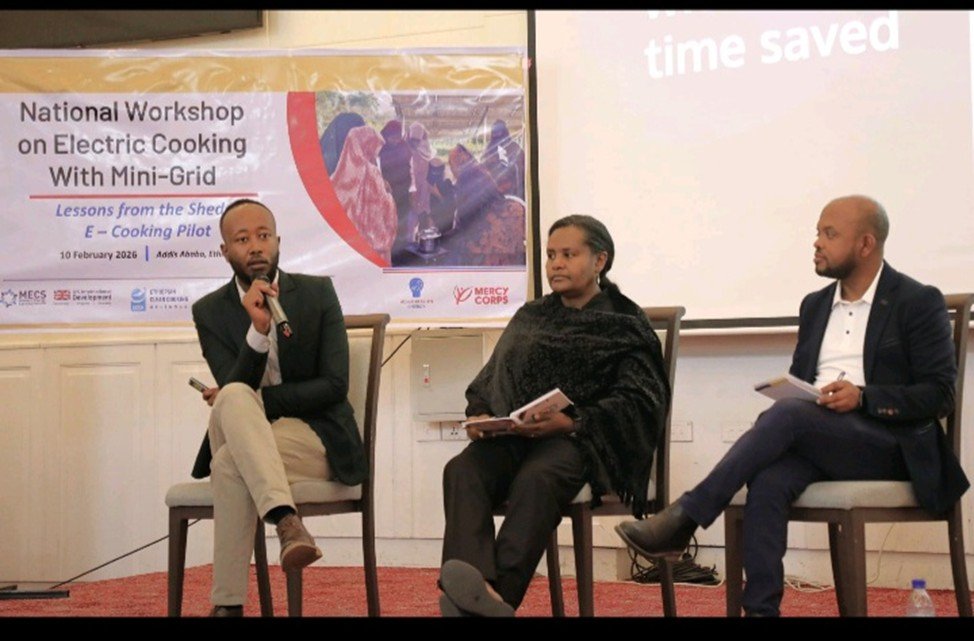
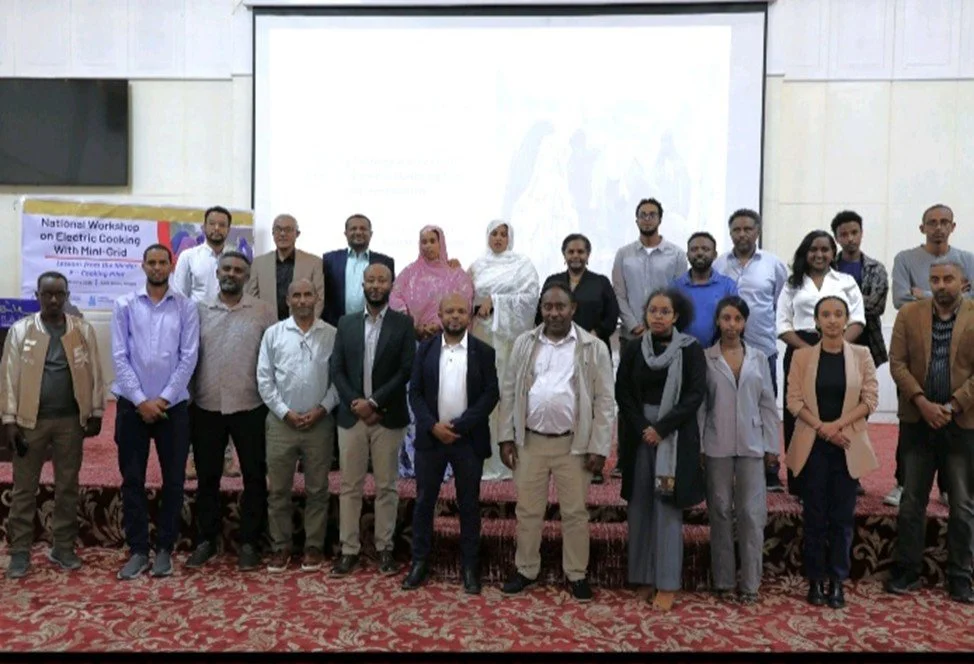
Photos from the national e-cooking workshop organised by Mercy Corps and the Ethiopian Clean Cooking Alliance (ECCA). Photo credit: Mercy Corps and ECCA
Gender & Energy Technical Working Group (GE-TWG): Strengthening Visibility, Policy Dialogue, and Women’s Leadership
At the latest GE‑TWG meeting held on 12 February 2026, Dr Getachew Bekele joined fellow JustGESI researchers Dr Guday Emirie (Associate Professor, Department of Sociology and Social Anthropology, Addis Ababa University) and Dr Amare Assefa (Lecturer, School of Electrical and Computer Engineering, College of Technology and Built Environment, Addis Ababa University). The session focused on two core agenda items:
updating the 2026 Action Plan, and
preparing for the International Women’s Day (March 8).
Discussions centered on deepening gender equality within Ethiopia’s energy sector through policy dialogues, showcasing women‑led enterprises, and gathering lived‑experience stories that highlight the everyday realities of women working across the energy landscape.
Key themes included:
clarifying the purpose and Terms of Reference (TOR) of the GE‑TWG
updates on ongoing GESI research (interviews, focus group discussions, institutional analysis, and mapping women’s decision‑making spaces)
strengthening collaboration with the Ministry of Water and Energy (MoWE) and the Ethiopian Women in Energy Association (EWiEN)
designing March 8 activities that move beyond symbolic recognition toward meaningful visibility and policy engagement
Following the meeting, Dr Getachew submitted a set of ‘March 8, 2026 Policy‑Change Asks,’ which included the following recommendations:
reserve a minimum quota (e.g., 30%) for women in energy‑project roles such as site management, maintenance teams, solar installation, and water‑point operations
mandatory Gender & Inclusion Compliance Plans for contractors during the bidding process
gender‑responsive training, financing, and entrepreneurship pipelines for women, including reserved places in clean‑energy programmes and targeted financing for women‑led SMEs
enforce a minimum of 40% representation of women (including young women and women with disabilities) across local councils, national committees, and public boards, supported by transparent accountability mechanisms such as public compliance dashboards
Those recommendations were well-received by the Ethiopian Women in Energy Association (EWiEN) and other members. In addition, the recommendations would be further presented at a high‑level meeting on March 8 that is expected to include the Minister of Water and Energy.
Talk Energy Ahead (TEA): Exploring Pyrolysis Stove Technology
During the 78th Talk Energy Ahead (TEA) session held on 26 February 2026, participants examined pyrolysis stove technology and the potential to transform agricultural waste into clean energy. The discussion covered pyrolysis stove innovation, agricultural waste-to-energy potential, biochar benefits, local production possibilities, and lessons from pilot projects.
Dr Getachew contributed by raising comparative questions about pyrolysis stoves versus other clean‑cooking alternatives, including improved biomass stoves, biogas systems, waste‑based biomass briquettes, and solar cookers. His intervention prompted a deeper exploration of the contexts, trade‑offs, and scalability of different clean‑cooking pathways.
