
Mainstreaming Gender Equality and Social Inclusion for a Just Energy Transition in Malawi: A Review of Malawi’s Clean Cooking Landscape
JustGESI team members Chrispin Gogoda, Christopher Hara, and Serena Saligari present a report providing an overview of Malawi’s clean cooking landscape from a gender equality and social inclusion (GESI) perspective. An executive summary of the report is provided below:
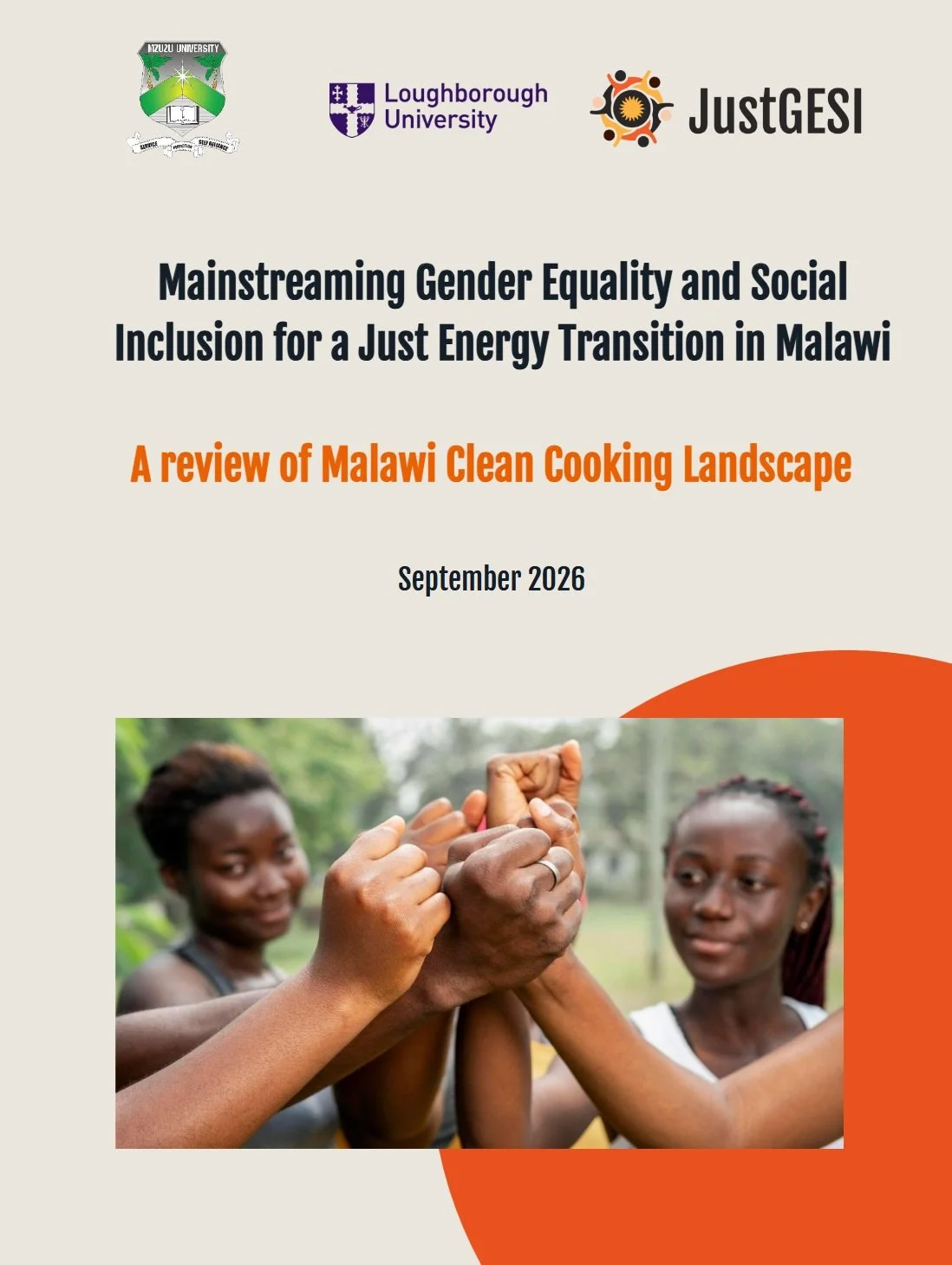
Cover page of the latest JustGESI report written by team members Chrispin Gogoda, Christopher Hara, and Serena Saligari on the clean cooking landscape in Malawi.
EXECUTIVE SUMMARY
Malawi’s transition to clean cooking remains a major energy, health, environmental, and social development challenge. Despite progress in electricity access, around 97% of households continue to rely on firewood and charcoal for cooking. Dependence on biomass contributes to household air pollution, deforestation, adverse health outcomes, and a disproportionate burden on women and girls, who are primarily responsible for fuel collection and cooking.
This report reviews Malawi’s clean cooking landscape, focusing on the potential of electric cooking (eCooking) to address these challenges and the importance of mainstreaming Gender Equality and Social Inclusion (GESI) to achieve a just energy transition. Electricity access increased from 8% in 2014 to 19% in 2018 to 25.9% in 2025, although significant urban-rural disparities persist. Grid access remains low at 11.3% in 2025, making off-grid systems increasingly important for expanding energy access. However, limited generation capacity, frequent load shedding, and affordability concerns continue to constrain the use of electricity for cooking.
Malawi has established a supportive policy environment for clean cooking through the National Energy Policy, National Charcoal Strategy, Renewable Energy Strategy, Nationally Determined Contributions, and the 2024 eCooking Roadmap. Recent policy developments increasingly recognise eCooking as a strategic pathway to reducing biomass dependence, including proposed tax exemptions for eCooking appliances, dedicated eCooking tariffs, and integration with rural electrification initiatives. Nevertheless, implementation remains slow and requires stronger coordination, investment, and market development.
Over the past decade, government and development partners have implemented a range of clean cooking initiatives, including the distribution of more than two million improved cookstoves, promotion of alternative fuels such as LPG, pellets, and briquettes, and a growing portfolio of eCooking pilots. While improved cookstoves have reduced fuel consumption and smoke exposure, they have not eliminated dependence on biomass. LPG adoption remains limited due to affordability, supply constraints, and safety concerns.
eCooking is emerging as a particularly promising solution. Projects employing electric pressure cookers, induction stoves, mini-grids and solar-powered cooking systems in communities, institutional settings and refugee camps demonstrate potential benefits including reduced cooking costs, lower pressure on forests, improved household health, and significant time savings for women. Electric pressure cookers, in particular, have been shown to be among the most cost-effective clean cooking options when appliance efficiency is considered. However, barriers such as high upfront costs, unreliable electricity supply, limited technology availability, cultural preferences, low awareness, and weak market structures continue to hinder widespread adoption.
GESI considerations are central to Malawi’s clean cooking transition. Women and girls experience the greatest health and time burdens associated with traditional cooking practices but also stand to gain the most from access to modern cooking technologies. A successful transition therefore requires the active participation of women and marginalised groups not only as users, but also as entrepreneurs, technicians, and decision-makers within the clean cooking value chain.
Achieving universal access to clean cooking will require a coordinated approach that combines reliable electricity infrastructure, affordable financing mechanisms, locally appropriate technologies, supportive policies, and inclusive implementation. With sustained investment and stronger integration of GESI principles, eCooking can play a transformative role in advancing energy access, public health, environmental sustainability, and gender equality in Malawi.
