JustGESI Ethiopia Hosts Stakeholder Consultation at Addis Ababa University
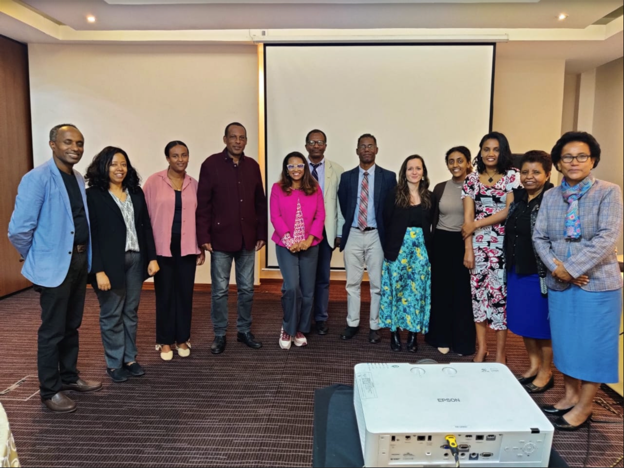
Stakeholder Workshop at Addis Ababa University. (Photo Credit: JustGESI Ethiopia Team)
The JustGESI Ethiopia team held a stakeholder workshop at Addis Ababa University on 27 August 2026, bringing together representatives from the Ministry of Water and Energy, Ethiopian Women in Energy (EWiEn), the Petroleum and Energy Authority, GIZ, and Agence Française de Développement (AFD) among others. The workshop introduced the JustGESI project and outlined the aims of Work Package 2, which focuses on institutional change within energy sector.
Stakeholder discussions explored institutional entry points, key policy documents, potential fieldwork participants, and practical approaches to data collection for the JustGESI research team. Participants represented a wide range of institutions, including government bodies, regulators, energy utilities, professional associations, development partners, civil society groups, and GESI organisations.
A central theme that emerged during the discussions was that having gender and inclusion policies in place did not necessarily guarantee a just and inclusive energy transition. Participants noted that policy commitments often fall short in practice due to limited resources, unclear institutional ownership, weak accountability and enforcement, and constraints affecting the authority and capacity of gender structures. These discussions reinforced the importance of Work Package 2 in examining how institutional policies and other formal texts are understood and put into practice, and how they shape everyday decisions, work processes, resource allocation, and people's lived experiences.
The workshop also helped refine the scope of the next research phase. Participants recommended reviewing NEP 2.0 and NEP 3.0, off‑grid directives, utility investment plans, Energy Compacts, and the National Sustainable Energy Development Strategy 2024-2030. They also called for stronger engagement with EEP, EEU, PEA, MoWSA, and the Ministry of Agriculture, particularly around productive use of energy initiatives. Additional perspectives from the Ministry of Labor and Skills, the Ethiopian Cooperative Commission, the African Development Bank, and AFD were identified as valuable for understanding institutional and financing dynamics.
Participants further helped clarify the geographic and demographic focus of upcoming fieldwork. Initial research will take place in Afar, Somali, and Sidama regions, with particular attention to pastoralist communities and other marginalised groups. The experiences of urban women who collect firewood in Addis Ababa were also highlighted as an important area of inquiry. Stakeholders stressed the need for context‑sensitive fieldwork that took into consideration languages, social conditions, and daily realities, supported by practical and activity‑based methods and appropriate institutional access arrangements.
The next step for the JustGESI team is to translate the workshop’s discussions into a clear, validated engagement and fieldwork plan. This will involve confirming stakeholder focal points, expanding and reviewing the inventory of relevant texts, and selecting two to three priority texts and institutional processes for more detailed analysis. It will also require finalising participant groups and field sites, securing institutional access and the necessary ethical and consent arrangements, and designing fieldwork that can effectively trace the connection between formal policy commitments and what actually happens in institutional practice and in people's everyday lives.
