
Mainstreaming Gender Equality and Social Inclusion in Tanzania’s Modern Cooking Transition: Insights from the JustGESI Report
JustGESI team members Estomih Sawe, Donata Didas, Mary Swai and Jensen Shuma from TaTEDO-SESO, Tanzania, supported by Serena Saligari (Loughborough University), present a report providing an overview of Tanzania's transition to modern cooking from a GESI perspective. An executive summary of the report is provided below:
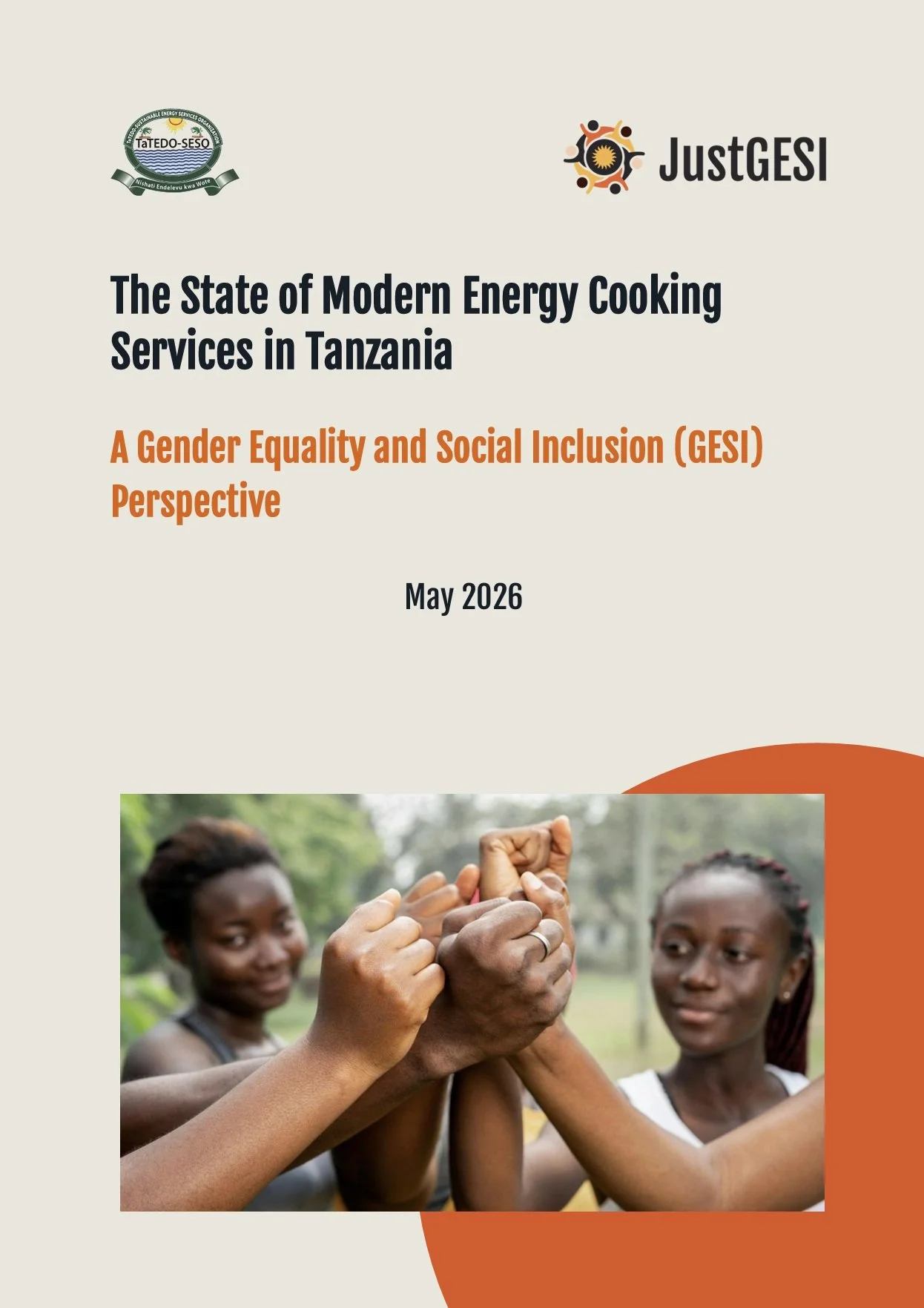
Cover page of the latest JustGESI report, written by team members Estomih Sawe, Donata Didas, Mary Swai and Jensen Shuma from TaTEDO-SESO Tanzania, supported by Serena Saligari from Loughborough University.
Tanzania is at a pivotal moment in its clean energy transition. With a goal of achieving 75 percent of electricity connectivity by 2030 (REA, 2022), alongside strong national frameworks such as the National Clean Cooking Strategy (NCCS) 2024–2034, the country is well-positioned to accelerate the shift from biomass to modern, efficient, and inclusive electric cooking (eCooking) solutions. This report examines the opportunities, barriers, policies, and gender equality and social inclusion (GESI) dynamics influencing this transition. Adopting a qualitative research approach, the study draws on extensive academic and grey literature, national surveys, and semi-structured interviews with diverse stakeholders (government agencies, private sector actors, civil society, and end-users) to provide a comprehensive analysis of the current eCooking landscape of Tanzania.
Despite the enabling policy environment, eCooking adoption remains critically low across the country. Currently, only about 2% of households use electricity as their primary cooking fuel, while over 80% continue to rely on traditional biomass. Reliance on firewood and charcoal drives deforestation and household air pollution (HAP), contributing to more than 33,000 premature deaths annually and leading to over US$39 billion of economic losses. The study finds that while awareness of eCooking benefits (improved health, time efficiency, and environmental sustainability) is gradually increasing, uptake is hindered by deep-seated structural and socio-cultural barriers.
Key findings reveal that high upfront appliance costs, unreliable electricity supply, and persistent misconceptions regarding electricity costs constrain the transition to eCooking. Although the market offers over 16 types of imported appliances, affordability remains low for the average household. Market growth is further stifled by limited financing options, inconsistent appliance quality, and weak after-sales support. The study also highlights the prevalence of fuel stacking and behavioral resistance, with cultural preferences regarding food taste and deep-seated cooking habits slowing the shift away from traditional fuels.
Gender equality and social inclusion (GESI) are central to this study’s analysis. Women, as the household members traditionally in charge of tending to energy needs and the primary users of cooking technologies, bear the disproportionate burden of fuelwood collection and exposure to HAP. However, research indicates that women often lack the decision-making power and financial autonomy to purchase eCooking appliances. Furthermore, tenants in multi-tenanted buildings face disincentives due to shared metering systems, and marginalized groups remain underserved by current interventions due to insufficient disaggregated data and GESI integration.
On the policy front, while the NCCS and the National Energy Efficiency Strategy (NEES) 2024–2034 provide clear direction, gaps in policy implementation and weak institutional coordination pose significant hurdles. Initiatives by sector actors—such as TANESCO’s on-bill financing, the "Pika Smart" awareness campaign, and result-based financing subsidies—demonstrate growing momentum. Yet, to unlock the full potential of eCooking, a more holistic approach is required.
The report recommends intensified public awareness campaigns to drive behavior change and the expansion of inclusive appliance financing models to address affordability barriers. Strengthening appliance standards, ensuring robust after-sales support, and improving grid reliability are essential technical steps. Institutionally, there must be a stronger focus on GESI-sensitive programming and improved data systems to track gender and social equity outcomes. Finally, deeper coordination among government, utilities, private companies, and development partners is necessary to ensure that Tanzania’s clean cooking transition is equitable and leaves no one behind. With strategic interventions, Tanzania can position itself as a continental leader in eCooking innovation, enhancing the wellbeing of its women, youth, and marginalized groups while achieving its climate and development goals.
